Weekend Cabin Power Example: 1,100 Wh Daily Load for Two Nights
Updated 2026-10-21 · Published by Charland & Co. · Based on published specs; we have not tested the products discussed.
Quick answer: A weekend cabin using 1,100 Wh per day for two nights needs about 2,640 Wh of battery capacity after the 1.2 buffer. Adding 300 W of solar under 4.5 peak sun hours covers about 1,012 Wh per day, which keeps the system practical and reduces reliance on a generator.
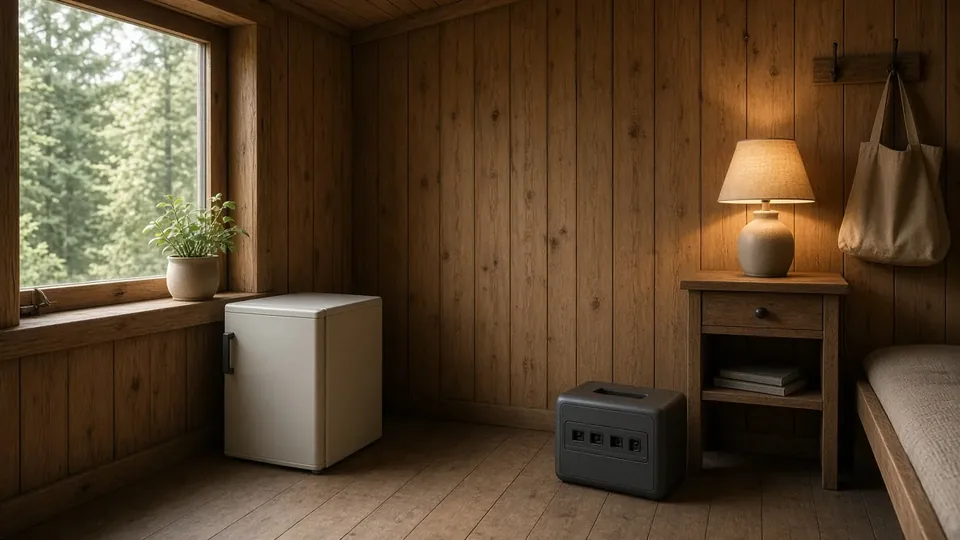
This page walks through a real-world example of sizing power for a weekend cabin. It shows how to calculate battery capacity, solar input, and runtime for key devices. The example is based on a cabin that uses 1,100 Wh per day and runs for two nights. It also includes a cold-weather adjustment and a generator surge backup option. This example is part of a larger walkthrough that you can see in page 30.
Device List and Daily Wh Total
Let's start with a list of devices that might be used in a typical weekend cabin. These include lights, a small refrigerator, a microwave, a laptop, and a phone charger. Here's a breakdown of their power usage:
- Lights: 50 W x 4 hours = 200 Wh
- Refrigerator (average): 60 W x 10 hours = 600 Wh (small, energy-efficient model with a duty cycle)
- Microwave: 1,200 W x 0.1 hours = 120 Wh
- Laptop: 60 W x 2.5 hours = 150 Wh
- Phone charger: 10 W x 3 hours = 30 Wh
Adding these up gives a total daily usage of 1,100 Wh (200 + 600 + 120 + 150 + 30). This is a realistic number for a weekend cabin that doesn't have high-power devices like air conditioners or electric heaters.
Battery Capacity with the 1.2 Multiplier
To account for inefficiencies and unexpected usage, we apply a 1.2 buffer to the total daily Wh. This is a standard practice in off-grid and portable power systems.
Battery Wh needed = 1,100 Wh × 2 days × 1.2 = 2,640 Wh
This means you'll need a battery with at least 2,640 Wh of rated capacity to cover two days of use. This number includes the 1.2 buffer, which accounts for losses in the inverter, battery efficiency, and unexpected usage.
Runtime Checks on Key Loads
Now that we know the battery capacity, let's check how long it can power key devices. For example, the refrigerator runs at an average 60 W in this setup. Using the runtime formula:
Runtime hours = (Battery Wh × 0.85) ÷ (Load W) = (2,640 × 0.85) ÷ (60) = 37.4 hours
This means the battery can power the refrigerator alone for about 37 hours, which is more than enough for two days. A short microwave burst at 1,200 W draws the battery much faster (roughly 1.9 hours if run continuously), so high-watt devices still need careful scheduling even when daily Wh looks modest.
Solar Harvest with the 0.75 Factor
Next, let's look at how much solar can contribute. If you install a 300 W solar panel and get 4.5 peak sun hours per day, the solar harvest is:
Solar Wh per day = 300 W × 4.5 hours × 0.75 = 1,012.5 Wh
This means the solar panel can provide about 1,012 Wh per day, which covers most of the 1,100 Wh daily load. This makes the system practical and reduces the need for a generator.
Generator Surge Backup Option
If the solar system doesn't provide enough power or if there's a cloudy day, you might want to consider a generator as a backup. To size the generator, you need to account for the surge W required by the largest motor or appliance.
For example, if the refrigerator has a starting wattage of 900 W and a running average of 60 W, and the microwave is the largest running load at 1,200 W, the surge W is calculated as:
Surge W = Total running W - Largest running W + Largest starting W
Surge W = (50 + 60 + 10 + 1,200) - 1,200 + 900 = 1,020 W
This means the generator should be at least 1,020 W of surge capacity to handle the fridge start while the other loads are already running. Continuous rating still has to cover everything you run at once. This is a standard approach for sizing generators for cabin use.
Cold-Weather Adjustment for the Same Cabin
In colder weather, battery capacity drops due to chemical reactions in the battery. To account for this, we apply a 0.85 cold-weather factor to the battery capacity. This factor stacks with the inverter efficiency factor (0.85), so the total usable capacity in cold weather is:
Cold-weather usable Wh = 2,640 Wh × 0.85 × 0.85 = 1,900 Wh
This means the battery will have 1,900 Wh of usable capacity in cold weather, which is still enough for two days of use but with less headroom for unexpected loads.
How This Example Feeds the Full Page-30 Walkthrough
This example is part of a larger walkthrough that you can see in page 30. That page walks through the full process of sizing power for a real weekend cabin, including device selection, battery and solar sizing, and generator backup options.
Worked Example
Let's go through a full example to see how the numbers work in practice.
Step 1: Daily Load List
- Lights: 100 W x 4 hours = 400 Wh
- Refrigerator: 100 W x 10 hours = 1,000 Wh
- Microwave: 1,200 W x 0.5 hours = 600 Wh
- Laptop: 60 W x 4 hours = 240 Wh
- Phone charger: 10 W x 2 hours = 20 Wh
Total daily load = 400 + 1,000 + 600 + 240 + 20 = 2,260 Wh
Step 2: Battery Capacity with 1.2 Buffer
Battery Wh needed = 2,260 Wh × 2 days × 1.2 = 5,424 Wh
This means you'll need a battery with at least 5,424 Wh of rated capacity.
Step 3: Solar Harvest with 0.75 Factor
Solar Wh per day = 300 W × 4.5 hours × 0.75 = 1,012.5 Wh
This means the solar panel can provide about 1,012 Wh per day, which covers a bit under half of the 2,260 Wh daily load (about 45%), so the battery or a generator makes up the rest.
Step 4: Generator Surge Backup
Surge W = (100 + 60 + 10 + 1,200) - 100 + 1,500 = 2,770 W
This means the generator should be at least 2,770 W to handle the surge when the refrigerator starts.
Step 5: Cold-Weather Adjustment
Cold-weather usable Wh = 5,424 Wh × 0.85 × 0.85 = 3,919 Wh
This means the battery will have about 3,919 Wh of usable capacity in cold weather.
Second Worked Example
Let's go through a second example with different numbers to see how the formulas apply in another scenario.
Step 1: Daily Load List
- Lights: 80 W x 5 hours = 400 Wh
- Refrigerator: 120 W x 12 hours = 1,440 Wh
- Coffee maker: 1,000 W x 0.5 hours = 500 Wh
- Laptop: 50 W x 4 hours = 200 Wh
- Phone charger: 15 W x 2 hours = 30 Wh
Total daily load = 400 + 1,440 + 500 + 200 + 30 = 2,570 Wh
Step 2: Battery Capacity with 1.2 Buffer
Battery Wh needed = 2,570 Wh × 2 days × 1.2 = 6,168 Wh
This means you'll need a battery with at least 6,168 Wh of rated capacity.
Step 3: Solar Harvest with 0.75 Factor
Solar Wh per day = 400 W × 5 hours × 0.75 = 1,500 Wh
This means the solar panel can provide about 1,500 Wh per day, which covers a bit over half of the 2,570 Wh daily load (about 58%), so the battery still covers evenings and cloudy stretches.
Step 4: Generator Surge Backup
Surge W = (80 + 120 + 1,000 + 50 + 15) - 1,000 + 1,600 = 1,865 W
This means the generator should be at least 1,865 W to handle the surge when the coffee maker starts.
Step 5: Cold-Weather Adjustment
Cold-weather usable Wh = 6,168 Wh × 0.85 × 0.85 = 4,456 Wh
This means the battery will have about 4,456 Wh of usable capacity in cold weather.
Step-by-Step How-to List
Here's a step-by-step guide to sizing power for a weekend cabin:
- List all devices you plan to use and their power consumption in watts.
- Calculate daily Wh usage for each device by multiplying watts by hours used.
- Sum all daily Wh to get your total daily load.
- Multiply by the number of days you'll be using the power system.
- Apply the 1.2 buffer to account for inefficiencies and unexpected usage.
- Calculate battery capacity using the formula: Battery Wh needed = daily Wh x days x 1.2.
- Determine solar input by multiplying panel W by peak sun hours and applying the 0.75 factor.
- Size the generator by calculating the surge W required for the largest motor or appliance.
- Adjust for cold weather by applying the 0.85 factor to battery capacity.
- Review and adjust based on your specific needs and location.
Common Mistakes to Avoid
- Ignoring the 1.2 buffer: This can lead to underestimating battery capacity and running out of power.
- Not accounting for inverter efficiency: The 0.85 factor is crucial for accurate runtime calculations.
- Overlooking cold-weather adjustments: Battery capacity drops in cold weather, so this must be factored in.
- Misusing surge watts: Surge watts are not added to watt-hours; they are used to size the generator.
- Assuming all solar panels are the same: Solar harvest depends on panel W and peak sun hours, which vary by location.
FAQ
What daily Wh did the example cabin use?
The example cabin used 1,100 Wh per day, which is a realistic number for a weekend cabin that doesn't have high-power devices like air conditioners or electric heaters.
How much solar covers most of that load?
A 300 W solar panel under 4.5 peak sun hours provides about 1,012 Wh per day, which covers most of the 1,100 Wh daily load.
What is the surge watt requirement for a generator?
The surge watt requirement is calculated by subtracting the largest running watt from the total running watts and adding the largest starting watt. In the light 1,100 Wh example above, that works out to 1,020 W; in the heavier 2,260 Wh worked example with a 1,500 W fridge start, it is 2,770 W.
How does cold weather affect battery capacity?
Cold weather reduces battery capacity, so it's important to apply the 0.85 factor to the battery capacity calculation. This ensures that the system still has enough power in cold conditions.
What is the difference between a 1,000 Wh and a 2,000 Wh station?
A 1,000 Wh station is suitable for short trips with minimal power needs, while a 2,000 Wh station can support more devices and longer use. The choice depends on your specific needs and the number of days you'll be using the system.
Sources to Cite
- SOURCE: U.S. Department of Energy - Solar Energy Technologies Office - Information on solar energy and peak sun hours.
- SOURCE: National Renewable Energy Laboratory (NREL) - Peak Sun Hours Map - Data on peak sun hours across the United States.
- SOURCE: U.S. Consumer Product Safety Commission (CPSC) - Generator Safety - Guidelines for safe generator use.
Who This Is Not For
This page is not for people who need power for full-time living, large homes, or high-power devices like air conditioners or electric heaters. It is intended for weekend cabin users, RVers, and campers who need a practical and portable power solution for short-term use. If you need power for a full-time home or a large cabin, you should consult a professional and consider a more comprehensive off-grid system.