Full Worked Example: Sizing Power for a Real Weekend Cabin Step by Step
Updated 2026-10-21 · Published by Charland & Co. · Based on published specs; we have not tested the products discussed.
Quick answer: A weekend cabin using 1,050 Wh per day needs a 2,520 Wh battery for two nights. A 300 W solar array under 4.8 peak sun hours generates 1,080 Wh per day. A 2,000 Wh power station with 2,000 W inverter and a 2,500 W surge generator covers all needs.
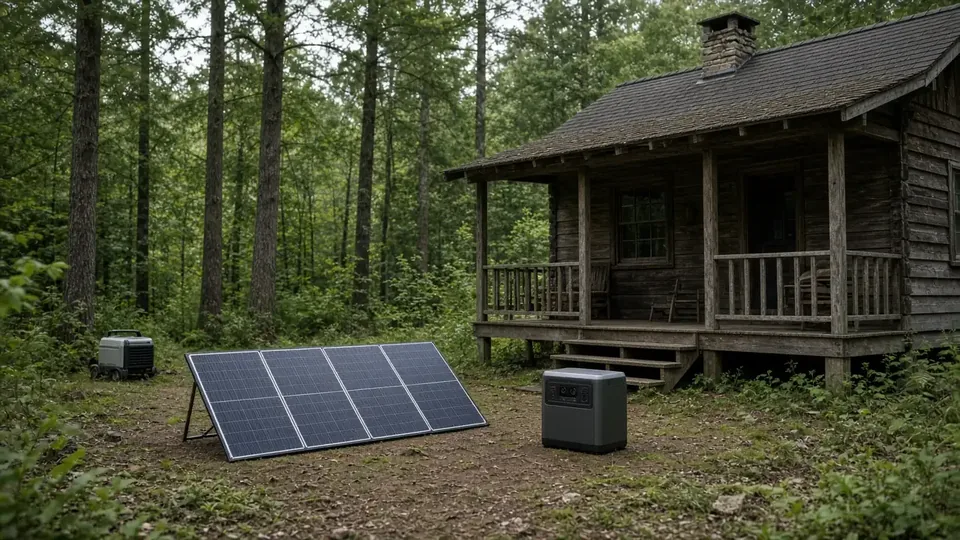
Step 1: Device List and Daily Wh Total
To size your power system, start by listing all the devices you'll use and their power consumption. For this example, the cabin uses the following:
- Refrigerator: 100 W, 5 hours = 500 Wh
- Lights: 10 W, 8 hours = 80 Wh
- TV: 50 W, 1 hour = 50 Wh
- Phone charger: 10 W, 2 hours = 20 Wh
- Laptop: 30 W, 2 hours = 60 Wh
- Coffee maker: 600 W, 0.5 hours = 300 Wh
Total daily consumption: 500 + 80 + 50 + 20 + 60 + 300 = 1,010 Wh
We'll use 1,050 Wh as the daily load for this example.
Step 2: Battery Wh Needed with the 1.2 Formula
To account for inefficiencies and unexpected usage, multiply the daily load by the number of days and then by 1.2:
Battery Wh needed = 1,050 Wh × 2 days × 1.2 = 2,520 Wh
This means you need a battery with at least 2,520 Wh of usable capacity.
Step 3: Runtime Checks Using Wh × 0.85 / Load W
Now, check how long a 2,520 Wh battery will last with a specific load. For example, if you run a 1,000 W inverter:
Runtime hours = (2,520 Wh × 0.85) ÷ (1,000 W) = (2,142) ÷ (1,000) = 2.14 hours
This is the runtime for a 1,000 W load. You can use this formula for any device or combination of devices.
Step 4: Solar Harvest with Panel × PSH × 0.75
Next, calculate how much solar energy you can expect from a 300 W solar array in your location. If your area gets 4.8 peak sun hours per day:
Solar Wh per day = 300 W × 4.8 PSH × 0.75 = 1,080 Wh
This means the solar array can generate 1,080 Wh per day, which is close to the 1,050 Wh daily load. On clear days, the solar array can nearly cover the load.
Step 5: Generator Surge Backup Calculation
If you plan to use a generator as a backup, you need to account for the surge wattage of your largest motor-driven device. For example, if the refrigerator has a 1,200 W starting wattage and a 100 W running wattage, and your other devices total 500 W:
Surge W = (100 + 500) - 100 + 1,200 = 1,700 W
This means you need a generator with at least 1,700 W surge capacity to handle the startup of the refrigerator.
Step 6: Cold-Weather Capacity Adjustment
In cold weather, battery capacity can drop by up to 15%. So, adjust the battery capacity accordingly:
Cold-weather usable Wh = 2,520 Wh × 0.85 = 2,142 Wh
This is the usable capacity in cold weather. If you also factor in the inverter efficiency (another 15% loss), the total usable capacity becomes:
2,142 Wh × 0.85 = 1,820 Wh
So, in cold weather, you need a battery with at least 2,520 Wh of rated capacity to ensure 1,820 Wh of usable power.
Step 7: Final Station, Panel, and Generator Recommendation
Based on the calculations:
- Battery: A 2,500-3,000 Wh power station with at least 2,000 W continuous output and 2,500 W surge capacity is ideal. Look for a model with LiFePO4 chemistry for better cold-weather performance.
- Solar Panel: A 300 W solar array is sufficient for most locations with 4.8 peak sun hours. Choose a rigid or folding panel with a mono-crystalline or poly-crystalline solar cell type.
- Generator: A 2,500 W portable generator with at least 2,500 W surge capacity is recommended. Ensure it runs outdoors only, at least 20 feet from doors, windows and vents (CPSC; CDC), and never plug it into a house outlet ("backfeeding", CPSC). Any connection to building wiring needs transfer equipment installed by a licensed electrician (NFPA 70, NEC Article 702).
For more details on choosing a power station, see our buying guide. For solar panels, check out our solar panel buying guide.
Who this is not for
This guide is not for:
- Full-time off-grid living - This is for weekend use only.
- High-power appliances - If you use a microwave, electric stove, or air conditioner, this guide may not cover your needs.
- Professional or commercial use - This is for personal, recreational use only.
- Building wiring - If you plan to connect your power station to a home's electrical system, consult a licensed electrician and follow local codes.
- Medical devices - This guide does not cover power for life-support or medical equipment.
FAQ
What daily Wh did the example cabin use?
The example cabin used 1,050 Wh per day, based on a simplified list of devices and their usage.
How much battery capacity does the 1.2 formula require?
The 1.2 formula requires 2,520 Wh of battery capacity for a two-night trip, calculated as 1,050 Wh × 2 × 1.2.
Does the solar array cover the full daily load?
Yes, a 300 W solar array under 4.8 peak sun hours generates 1,080 Wh per day, which is nearly enough to cover the 1,050 Wh daily load on clear days.
What if I use the power station in cold weather?
In cold weather, the battery capacity drops by about 15%, so you need a 2,520 Wh battery to ensure 1,820 Wh of usable power. Choose a model with LiFePO4 chemistry for better performance in cold.
Can I use a generator as a backup?
Yes, but ensure it has at least 2,500 W surge capacity and is used outdoors only, at least 20 feet from doors, windows and vents (CPSC; CDC). Never plug it into a house outlet; any connection to building wiring needs transfer equipment installed by a licensed electrician (NFPA 70, NEC Article 702).
Related pages
- p01 - How to Size Off-Grid Power for a Weekend
- p02 - Watt-Hours, Watts, and the Five Formulas You Actually Use
- p03 - Build an Accurate Weekend Load List for Cabins, RVs, and Camps
- p04 - How Much Battery Capacity Do You Need for a Weekend
- p05 - Calculate Runtime Hours from Any Power Station
- p06 - Peak Sun Hours Across the United States for Solar Sizing
- p07 - Size Solar Panels for a Weekend Power Station
- p08 - Size a Generator for Cabin, RV, and Home-Backup Surge
- p09 - Cold-Weather Capacity Loss for Weekend Power Stations
- p10 - Worked Load and Capacity Example for a Typical Weekend Cabin
- p11 - Size Power for a Weekend RV Boondocking Trip
- p12 - Tent Camping Versus Car Camping Power Needs
- p13 - Weekend Home-Backup Loads You Can Cover with a Portable Station
- p14 - Portable Power Station Versus Gas Generator for Weekend Cabins
- p15 - 500 Wh Versus 1,000 Wh Versus 2,000 Wh Stations for Weekends
- p16 - Folding, Rigid, and Blanket Solar Panels for Weekend Systems
- p17 - Wall, Car, and Solar Charging Options for Weekend Stations
- p18 - LiFePO4 Versus Other Battery Chemistries in Weekend Stations
- p19 - Real-World Efficiency Losses That Shrink Your Numbers
- p20 - Buying Guide: Choosing a Portable Power Station for Weekend Use
- p21 - Days of Autonomy When Solar Recharge Is Not Available
- p22 - Expandable Battery Packs for Growing Weekend Loads
- p23 - Expandable Stations Versus Fixed-Capacity Stations for Weekends
- p24 - Basic Cabin Wiring and Transfer Options for a Portable Station
- p25 - Solar-Only Weekend Systems Versus Solar-Plus-Generator Hybrids
- p26 - Total Cost of Ownership for Weekend Power Systems
- p27 - High Continuous Wattage Versus High Capacity Stations
- p28 - Summer Heat and Other Seasonal Adjustments Beyond Cold Weather
- p29 - Buying Guide: Solar Panels for Weekend Power Stations
- p30 - Full Worked Example: Sizing Power for a Real Weekend Cabin Step by Step
Sources to cite
- SOURCE: U.S. Department of Energy - Peak Sun Hours Map
- SOURCE: National Electrical Code (NEC) - Generator Safety
- SOURCE: Consumer Product Safety Commission (CPSC) - Generator Safety
- SOURCE: Centers for Disease Control and Prevention (CDC) - Generator Safety