Days of Autonomy When Solar Recharge Is Not Available
Updated 2026-10-21 · Published by Charland & Co. · Based on published specs; we have not tested the products discussed.
Quick answer: Battery Wh needed = daily Wh x days x 1.2. A cabin using 950 Wh a day for two nights with no solar needs about 2,280 Wh of rated capacity (950 x 2 x 1.2 = 2,280). Shop against that rated number; it delivers about 1,938 Wh to AC loads (x 0.85).
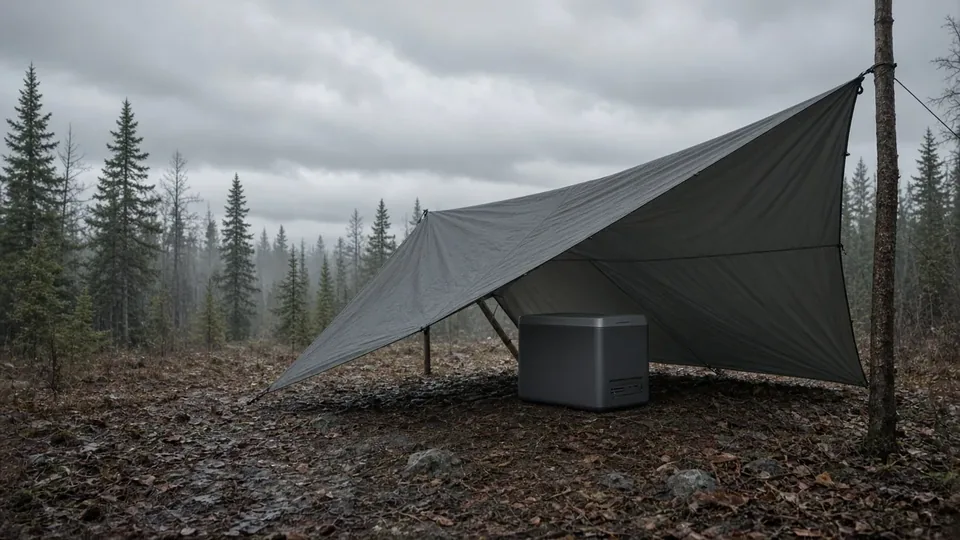
Days of autonomy means how long your battery bank can cover the cabin with zero solar recharge. That matters on cloudy weekends, under tree cover, or when you leave the panels at home. The core formula is the same one used across WeekendWatts:
Battery Wh needed = daily Wh x days x 1.2
The 1.2 factor is a planning margin for inverter losses you did not model separately, partial charges, and one stretch of higher use. It is not a free third night.
Setting the Autonomy Target for Weekend Trips
Most USA weekend cabin trips land on one of three targets:
- One night — arrive Friday, leave Saturday; one full evening and morning.
- Two nights — classic Friday-to-Sunday with no reliable sun.
- Three nights — long weekend or a forecast of two cloudy days in a row.
Start with a real daily Wh total from a device list (lights, fridge average, phones, laptop, short microwave bursts). Do not invent a round number. If your list is still rough, use a modest cabin example of 950 Wh/day as a planning placeholder, then replace it with your own sum before you buy.
Autonomy is about energy (Wh), not surge watts. Surge still has to clear the fridge start, but the day-count math is always daily Wh x days x 1.2.
Applying the Daily-Wh x Days x 1.2 Formula
Plug the numbers in every time. For the 950 Wh/day cabin and two nights with no solar:
950 × 2 = 1,900 \quad then \quad 1,900 × 1.2 = 2,280 Wh rated
So you need about 2,280 Wh of rated capacity on the station label. That is the number you shop against, not the usable Wh after losses.
One-night and three-night checks with the same daily load:
950 × 1 × 1.2 = 1,140 Wh rated
950 × 3 × 1.2 = 3,420 Wh rated
Two nights is the sweet spot for many weekend stations in the 2,000-3,000 Wh class. Three nights without solar often pushes you into expansion packs or a hybrid with a small generator.
One Cloudy Day Versus Two Cloudy Days
If you already have solar on site, autonomy planning changes. Size the battery for the gap after solar, not for the full daily load, when the panels will still run on clear hours.
Example using the same solar formula as the rest of the site (panel W x peak sun hours x 0.75):
200 × 5 × 0.75 = 750 Wh/day from solar
On a clear day with a 950 Wh load, net battery draw is 950 - 750 = 200 Wh. Two clear days then need only:
200 × 2 × 1.2 = 480 Wh rated
That is why a cloudy forecast matters. One fully cloudy day with zero harvest means you must cover that day's full 950 Wh from the battery (x 1.2 if you want margin on that day alone = 1,140 Wh). Two fully cloudy days return you to the zero-solar case: 950 x 2 x 1.2 = 2,280 Wh.
Practical rule: if the forecast shows two solid overcast days and you cannot relocate the panels, plan the full zero-solar autonomy number. If only one day looks bad, you can often ride a smaller bank and accept a tighter evening.
Usable Capacity After the 0.85 Runtime Factor
Rated Wh on the box is not what you get at the AC outlets. For runtime planning we apply the 0.85 inverter / system factor used site-wide:
Usable Wh (mild weather) = 2,280 × 0.85 = 1,938 Wh
So a station bought to the 2,280 Wh rated target delivers about 1,938 Wh to AC loads before it is empty under the 0.85 model.
Cold-weather stack (same as W02 / W10)
In cold weather, capacity falls further. We stack a second 0.85 on top of the inverter factor, matching the cold formula on the formulas and cabin-example pages:
Cold usable Wh = 2,280 × 0.85 × 0.85 ≈ 1,647 Wh
That is roughly 72% of rated (0.85 x 0.85 = 0.7225). On a freezing weekend with no solar, the same 2,280 Wh station feels closer to a 1,650 Wh tank. Either cut loads, add rated Wh, or add panels you can site in the sun.
LiFePO4 packs usually lose less than older chemistries, but they still should not be charged below 32°F unless the station has battery heating (EcoFlow DELTA 3 Classic spec: charge 32-113°F). Running from a cold pack is usually fine; charging is the restriction.
When to Stop Adding Battery and Add Solar Instead
Pure battery autonomy gets expensive and heavy past about three nights. Compare the two paths with the same 950 Wh/day load:
| Plan | Math | Rough station class |
|---|---|---|
| 2 nights, zero solar | 950 x 2 x 1.2 = 2,280 Wh | ~2,000-2,500 Wh |
| 3 nights, zero solar | 950 x 3 x 1.2 = 3,420 Wh | ~3,500 Wh or base + expansion |
| 2 nights, 750 Wh/day solar | (950 - 750) x 2 x 1.2 = 480 Wh | small bank + 200 W panel |
| 4 nights, zero solar | 950 x 4 x 1.2 = 4,560 Wh | large expandable bank |
Once the zero-solar number crosses ~3,500-4,000 Wh for a weekend-only cabin, a 200-400 W portable panel plus a mid-size station usually beats another expansion battery on cost and weight. Keep a generator or car charge as backup for multi-day storms rather than stacking endless packs.
Checking the Number Against Station Expandability
After you compute rated Wh needed, check three product facts on the maker page:
- Base rated Wh — does one unit clear your number?
- Expansion packs — same chemistry, same maker; note the max pack count and whether packs charge in parallel.
- AC continuous and surge W — autonomy math does not replace surge checks for the fridge start.
If you need 2,280 Wh and the base unit is 2,048 Wh, one matching expansion pack that brings the total to about 4,000 Wh gives headroom, not a tiny top-up. Prefer a single larger base when expandability is limited or when you hate packing a second brick.
Real Weekend Examples with Zero Solar
Example A — modest cabin, two nights, no solar
- Daily load: 950 Wh
- Days: 2
- Battery rated: 950 x 2 x 1.2 = 2,280 Wh
- Mild usable: 2,280 x 0.85 = 1,938 Wh
- Cold usable: 2,280 x 0.85 x 0.85 ≈ 1,647 Wh
Example B — FAQ case, 900 Wh/day, two nights
900 × 2 × 1.2 = 2,160 Wh rated
Mild usable = 2,160 x 0.85 = 1,836 Wh. Cold usable = 2,160 x 0.85 x 0.85 ≈ 1,560 Wh.
Example C — same 950 Wh cabin, one cloudy day only
If five peak-sun hours of a 200 W panel are lost for one day, cover that day from the battery: 950 x 1 x 1.2 = 1,140 Wh of rated margin dedicated to the cloudy day, on top of whatever you still need for evenings on the clear day.
Worked Example (Full Walkthrough)
- List devices and sum daily Wh → 950 Wh/day (placeholder until your list is done).
- Choose autonomy nights with no solar assumed → 2.
- Rated capacity: 950 x 2 x 1.2 = 2,280 Wh.
- Mild usable check: 2,280 x 0.85 = 1,938 Wh.
- Cold check: 2,280 x 0.85 x 0.85 ≈ 1,647 Wh.
- If a 200 W panel at 5 peak sun hours is available on clear days: solar = 200 x 5 x 0.75 = 750 Wh/day; net = 200 Wh/day; two clear days need only 200 x 2 x 1.2 = 480 Wh from the battery.
- Shop a station whose rated Wh meets the zero-solar number when the forecast is bad, and confirm surge W separately.
Step-by-Step How-to
- Build a daily Wh list with real hours.
- Pick 1, 2, or 3 nights of zero-solar autonomy.
- Compute daily Wh x days x 1.2 → rated Wh.
- Apply 0.85 for mild usable Wh.
- If nights are near freezing, also apply the stacked cold 0.85 (rated x 0.85 x 0.85).
- Compare that rated number to base stations and expansion packs.
- If rated need exceeds ~3,500 Wh for a weekend-only trip, price a portable panel before another pack.
- Recheck surge W for the largest motor start.
Common Mistakes
- Treating the 1.2 margin as a free extra night.
- Shopping usable Wh when labels show rated Wh.
- Ignoring cold stacking on fall and spring trips.
- Sizing for 24-hour continuous loads when real weekend hours are much lower.
- Adding a fourth expansion battery instead of a 200 W panel for multi-day sun.
FAQ
How much capacity covers two nights at 900 Wh per day?
Rated capacity = 900 x 2 x 1.2 = 2,160 Wh. Mild usable is about 1,836 Wh after x 0.85. Cold usable is about 1,560 Wh after x 0.85 x 0.85.
Does the 1.2 buffer replace a third night of autonomy?
No. The 1.2 factor is a planning margin for losses and messy real use. A third night still needs daily Wh x 3 x 1.2. For 950 Wh/day that is 3,420 Wh rated.
When is pure battery autonomy impractical?
For weekend cabins, pure battery starts to look heavy and costly past about three nights of zero solar (roughly 3,400 Wh+ at 950 Wh/day). Prefer solar harvest, a smaller generator, or cutting loads instead of endless packs.
How does cold weather change the autonomy number?
Keep the rated shopping number from daily x days x 1.2, then check cold usable with rated x 0.85 x 0.85. A 2,280 Wh station drops to about 1,647 Wh usable AC in the cold model, so either buy more rated Wh or plan fewer loads.
Should I size autonomy before or after solar?
Compute the zero-solar number first so a bad forecast does not strand you. Then compute a second, smaller number that subtracts expected solar Wh/day for clear-weather trips. Carry the larger of the two when storms are likely.
Does expandability change the formula?
No. Expansion packs only change how you reach the rated Wh target. The formula stays daily Wh x days x 1.2. Confirm the maker's max pack count and charge behavior on its spec page.
Related Pages
- Watt-Hours vs Watts: 5 Formulas
- How Much Battery Capacity for a Weekend
- Runtime Hours from Any Power Station
- Expandable Battery Packs
- Weekend Cabin Power Example
- Cold-Weather Capacity Loss
Sources to Cite
- NREL PVWatts — peak sun hours for solar-subtracted autonomy checks
- EcoFlow DELTA 3 Classic specs (example maker spec page, cold charging): https://www.ecoflow.com/us/delta-3-classic-portable-power-station/specs
Who This Is Not For
This page is not for full-time off-grid homes, multi-week expeditions, or whole-house backup during long outages. It is for USA weekend and seasonal cabin, RV, and camping loads measured in a few thousand watt-hours. If you need continuous power for many days, talk to a licensed electrician and size a proper off-grid or standby system.