Expandable Battery Packs for Growing Weekend Loads
Updated 2026-10-21 · Published by Charland & Co. · Based on published specs; we have not tested the products discussed.
Quick answer: Adding a 2,000 Wh expansion battery to a 2,000 Wh base unit gives 4,000 Wh total. For a cabin needing 1,667 Wh per day (after the 1.2 multiplier), this supports two nights of use.
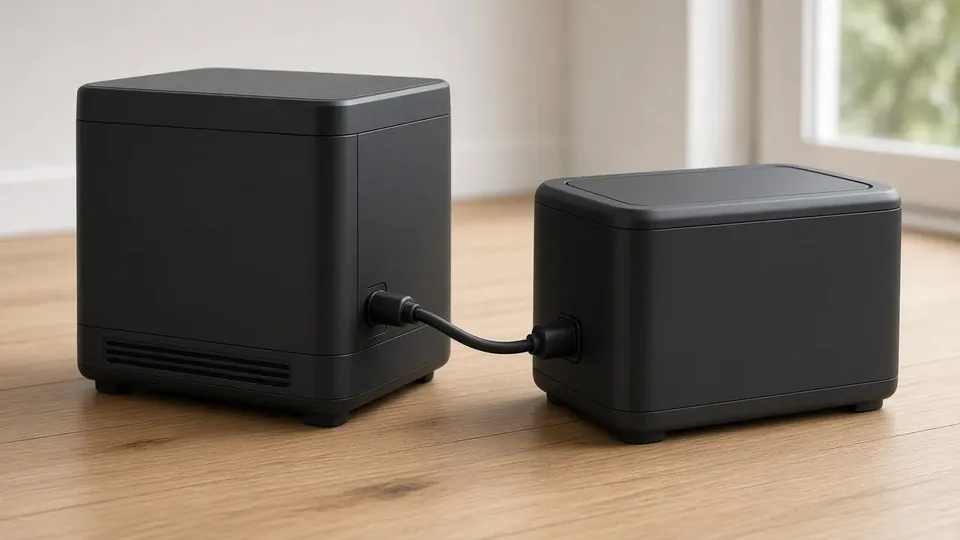
When you first set up your weekend cabin power system, you might not expect your needs to grow. But as you add more devices, spend more time off-grid, or upgrade your appliances, your power needs can increase. Expandable battery packs let you scale your system without buying a new power station. This page explains how they work, how to size them, and what to consider when choosing one.
How Expansion Packs Increase Total Wh
Each expansion pack adds its rated watt-hours (Wh) to the base unit's capacity. For example, a 2,000 Wh base unit with a 2,000 Wh expansion pack gives a total of 4,000 Wh. This is useful when your daily load increases, or when you want to extend your runtime without replacing your base station.
To calculate how much total capacity you need, use the battery Wh needed formula:
Battery Wh needed = Daily Wh × Days × 1.2
The 1.2 multiplier accounts for inefficiencies and unexpected use. If your base unit is 2,000 Wh and you add a 2,000 Wh expansion pack, your total capacity becomes:
2,000 Wh + 2,000 Wh = 4,000 Wh
This gives you more flexibility to support higher loads or longer stays.
Matching Expansion to the Battery-Needed Formula
Let's say you're planning a two-night trip and your daily load is 1,667 Wh. Using the battery Wh needed formula:
1,667 Wh × 2 days × 1.2 = 4,000 Wh
This matches the 4,000 Wh capacity of a 2,000 Wh base unit with a 2,000 Wh expansion pack. This means you can support two nights of use without needing a larger base unit.
If your load increases, you can add more expansion packs. For example, if you need 6,000 Wh total, you could use a 2,000 Wh base unit with two 2,000 Wh expansion packs.
Charge and Discharge Rates with Packs Attached
When you attach expansion packs, the charging and discharging rates of the system may change. Most systems charge and discharge at the same rate whether one or multiple packs are attached. However, some models may have a lower charge rate when multiple packs are connected.
For example, a power station that charges at 500 W with one pack might charge at 400 W with two packs. This is because the system may prioritize balancing the charge between packs. Always check the manufacturer's specifications for exact numbers.
Weight and Storage Trade-Offs
Adding expansion packs increases the total weight of your system. A 2,000 Wh base unit might weigh 15 lbs, and a 2,000 Wh expansion pack might weigh 12 lbs. Together, that's 27 lbs. If you're carrying your system by hand, this can be a consideration.
Storage is also affected. Expansion packs take up more space, so you'll need a larger bag or case to carry them. If you're storing your system in a vehicle, you'll need to plan for the extra space.
Solar Input Shared Across the System
When you use solar panels with an expandable system, the solar input is shared across all connected packs. This means that the solar panels charge the entire system, not just the base unit or one expansion pack.
For example, if you have a 100 W solar panel and a 2,000 Wh base unit with a 2,000 Wh expansion pack, the 100 W panel charges both units at the same time. This is efficient, but it also means that the charging speed depends on the total capacity of the system.
Limits on How Many Packs One Station Supports
Not all power stations support multiple expansion packs. Some models may only allow one or two packs to be attached. Always check the manufacturer's specifications to see how many expansion packs are supported.
For example, a model might support up to two 2,000 Wh expansion packs, giving a total capacity of 6,000 Wh. Other models may only support one expansion pack, limiting the total capacity to 4,000 Wh.
Planning Future Load Growth
When planning your system, it's important to think about how your load might grow over time. If you expect to add more devices or spend more time off-grid, you may want to choose a base unit and expansion packs that can scale with your needs.
For example, if you start with a 2,000 Wh base unit and one 2,000 Wh expansion pack, you can later add a second expansion pack if needed. This gives you flexibility without having to replace your entire system.
Step-by-Step Guide to Sizing an Expandable System
-
List your daily load in watt-hours (Wh): Use a load list to calculate your total daily consumption. For example, a microwave (1,000 W), a refrigerator (200 W), and a phone charger (10 W) for 1 hour each day would be 1,210 Wh.
-
Multiply by the number of days you need power for: If you're planning a 3-day trip, multiply your daily load by 3.
-
Apply the 1.2 multiplier for inefficiencies and unexpected use: This ensures you have enough capacity even if your usage varies.
-
Determine how many expansion packs you need: Subtract the base unit's capacity from the total battery Wh needed. If your base unit is 2,000 Wh and you need 4,000 Wh total, you'll need one 2,000 Wh expansion pack.
-
Check the system's compatibility with expansion packs: Ensure your base unit supports the number of expansion packs you plan to use.
-
Consider weight and storage: Expansion packs add weight and space, so plan accordingly for transport and storage.
-
Review cold-weather performance: Use the cold-weather usable Wh formula to adjust your capacity for lower temperatures.
Worked Example 1: Adding an Expansion Pack to a Base Unit
Scenario: You have a 2,000 Wh base unit and a 2,000 Wh expansion pack. Your daily load is 1,667 Wh, and you plan a two-night trip.
Step 1: Calculate total battery capacity
2,000 Wh + 2,000 Wh = 4,000 Wh
Step 2: Calculate battery Wh needed
1,667 Wh × 2 days × 1.2 = 4,000 Wh
Step 3: Compare total capacity to battery Wh needed
4,000 Wh = 4,000 Wh
This means your system supports two nights of use with no extra capacity.
Worked Example 2: Adding Two Expansion Packs to a Base Unit
Scenario: You have a 2,000 Wh base unit and two 2,000 Wh expansion packs. Your daily load is 1,500 Wh, and you plan a three-night trip.
Step 1: Calculate total battery capacity
2,000 Wh + 2,000 Wh + 2,000 Wh = 6,000 Wh
Step 2: Calculate battery Wh needed
1,500 Wh × 3 days × 1.2 = 5,400 Wh
Step 3: Compare total capacity to battery Wh needed
6,000 Wh > 5,400 Wh
This means your system supports three nights of use with extra capacity for unexpected use.
Common Mistakes to Avoid
-
Ignoring the 1.2 multiplier: This is a key part of the battery Wh needed formula. Failing to include it can lead to underestimating your power needs.
-
Assuming expansion packs double runtime exactly: Runtime depends on your load, and the 0.85 inverter efficiency factor must be applied to both the base unit and expansion packs.
-
Not checking compatibility: Not all power stations support expansion packs. Always verify the manufacturer's specifications.
-
Overlooking cold-weather performance: Use the cold-weather usable Wh formula to adjust your capacity for lower temperatures.
-
Not planning for weight and storage: Expansion packs add weight and space, which can affect your transport and storage options.
FAQ
Does an expansion pack double runtime exactly?
No. Adding an expansion pack increases total capacity, but runtime depends on your load. For example, a 2,000 Wh base unit with a 2,000 Wh expansion pack gives 4,000 Wh total. If your load is 1,000 W, runtime is:
4,000 Wh × 0.85 / 1,000 W = 3.4 hours
If you only had the base unit, runtime would be:
2,000 Wh × 0.85 / 1,000 W = 1.7 hours
So the expansion pack doubles runtime in this case, but it depends on your load.
Can I charge the expansion pack independently?
Most expansion packs are designed to be charged together with the base unit. Some models allow you to charge the expansion pack separately, but this is rare. Always check the manufacturer's specifications.
How does expansion change the cold-weather derate?
Cold weather reduces battery capacity. The cold-weather usable Wh is calculated as:
Cold-weather usable Wh = Wh × 0.85
This applies to both the base unit and expansion packs. So, if you have a 2,000 Wh base unit and a 2,000 Wh expansion pack, cold-weather usable capacity is:
(2,000 + 2,000) × 0.85 = 3,400 Wh
This is a 15% reduction in usable capacity due to cold weather.
What if I need more than one expansion pack?
If your battery Wh needed exceeds the capacity of one expansion pack, you can add multiple packs. For example, if your base unit is 2,000 Wh and you need 6,000 Wh total, you can add two 2,000 Wh expansion packs.
How does solar charging work with expansion packs?
Solar panels charge the entire system, including the base unit and all expansion packs. The solar Wh per day is calculated as:
Solar Wh per day = Panel W × Peak Sun Hours × 0.75
This ensures you account for solar efficiency.
Related Pages
- p04 /battery-wh-needed-weekend
- p05 /runtime-hours-battery-wh
- p23 /expandable-vs-fixed-capacity-station
- p21 /battery-autonomy-days-weekend
- p02 /watt-hours-vs-watts-formulas
Sources to Cite
- SOURCE: Charland & Co.
- SOURCE: Manufacturer specifications for expandable battery packs
- SOURCE: Battery efficiency in cold weather
Who This Is Not For
This page is not for users who need a fixed-capacity system or who are not planning for future load growth. It's also not for users who need a system that can be charged independently or who require high continuous wattage for heavy-duty appliances. If you need a system that can be used for home backup or for extended off-grid use, this page may not be the best fit for you.