Expandable Stations Versus Fixed-Capacity Stations for Weekends
Updated 2026-10-21 · Published by Charland & Co. · Based on published specs; we have not tested the products discussed.
Quick answer: A fixed 2,048 Wh station covers about 1,700 Wh of daily load for one night after the 1.2 buffer, while an expandable 2,048 Wh base that accepts one extra pack covers the same load for two nights. Expandability costs more upfront but avoids a full replacement when weekend needs grow.
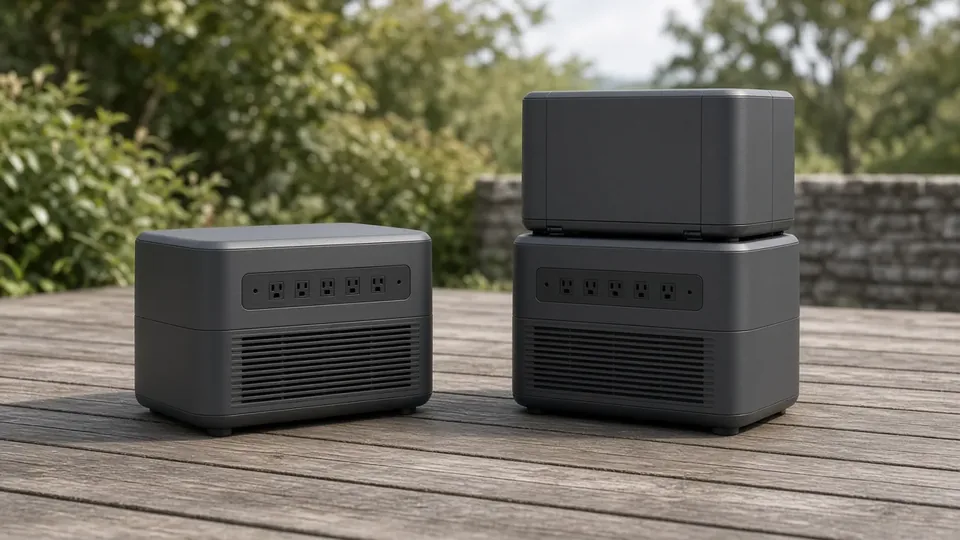
Choosing between an expandable and a fixed-capacity power station affects how well your weekend setup meets your needs. Expandable models let you add battery packs later, while fixed-capacity models have a set storage limit. This page compares the two based on cost, flexibility, and performance to help you decide what works best for your weekend trips.
Upfront Cost Versus Future Flexibility
Fixed-capacity stations are usually cheaper to buy at first. An expandable base with the same capacity usually costs more, because you pay for the expansion port and hardware. Compare current prices at the retailer; prices change often.
Expandable stations can save money in the long run. If your weekend power needs grow—like using more appliances or staying away from home longer—adding a second battery is often cheaper than buying a new, larger fixed-capacity station. This makes expandable models a good choice for people expecting their needs to change over time.
Runtime Comparison on the Same Daily Load
Suppose your weekend load is 1,000 Wh per day. To account for inefficiencies and unexpected use, aim for at least 1,200 Wh of battery capacity. Using the formula:
Battery Wh needed = daily Wh x days x 1.2
For one night:
1,000 Wh x 1 x 1.2 = 1,200 Wh
A fixed 2,048 Wh station would work for one night with extra capacity left. But for two nights, you’d need at least 2,400 Wh, which means buying a new, larger fixed-capacity station.
An expandable 2,048 Wh base that takes one more 2,048 Wh pack can handle two nights. The total becomes 4,096 Wh, more than enough for two nights of 1,000 Wh use. This flexibility is a key benefit of expandable systems.
Portability When Packs Are Added
A downside of expandable stations is that they get heavier as you add more packs. A single 2,048 Wh unit might weigh 15 pounds, but adding a second pack could push the total to 30 pounds or more. This makes the system harder to carry, especially if you're hiking or moving it often.
Fixed-capacity stations stay the same size and weight no matter how much power they hold. This makes them more convenient for users who value portability and easy transport.
Warranty and Compatibility Differences
Expandable stations often have warranties that cover both the base and extra battery packs. But check the terms carefully—some may only cover the base unit. Others extend the warranty to all compatible packs.
Fixed-capacity stations usually have a single warranty that covers the whole unit. This can be simpler to manage if you don’t plan to add extra packs later.
Compatibility is important too. Not all expandable stations accept the same battery packs. When shopping, make sure the packs you want are compatible with your base unit, especially if you plan to upgrade your system.
Solar and Charging Behavior
Expandable and fixed-capacity stations charge similarly with solar panels. Both can be charged using solar, and the time depends on the panel wattage and sunlight available.
Using the formula:
Solar Wh per day = panel W x peak sun hours x 0.75
For a 100 W panel and 5 peak sun hours:
100 W x 5 x 0.75 = 375 Wh
This means it would take about 5.5 days of full sun to recharge a 2,048 Wh fixed station. An expandable system with two 2,048 Wh packs would take about 11 days under the same conditions.
Expandable stations can be charged with multiple solar panels at once, which speeds up the process. This is a key advantage if you're using your station in remote areas where solar is the main charging method.
Best Fit for Stable Versus Growing Loads
Fixed-capacity stations work best for users with stable power needs. If you know exactly how much power you’ll need and don’t expect your usage to change, a fixed-capacity model is a good, cost-effective choice.
Expandable stations are better for users whose needs are likely to grow. Whether you're planning to stay away from home longer or use more appliances, an expandable model gives you the flexibility to scale your system as needed.
Decision Checklist
Here's a quick checklist to help you choose:
- Do I expect my power needs to grow? If yes, consider an expandable station.
- Am I prioritizing portability? If yes, a fixed-capacity station may be better.
- Can I afford the upfront cost of an expandable system? If yes, it may be worth the investment for long-term flexibility.
- Do I need to charge the station using solar panels? Both types can use solar, but expandable systems may take longer to recharge fully.
- Do I need a warranty that covers additional battery packs? Check the warranty terms carefully if you're considering an expandable system.
Worked Example
You're planning a weekend trip with a daily load of 1,000 Wh and want to cover two nights. Here's how to size your power station:
- Calculate battery Wh needed for two nights:
Battery Wh needed = daily Wh x days x 1.2 = 1,000 x 2 x 1.2 = 2,400 Wh
- Choose between a fixed or expandable station:
- A fixed 2,048 Wh station would only cover about 1,700 Wh after the 1.2 buffer, which is not enough for two nights.
- An expandable 2,048 Wh base with one additional 2,048 Wh pack would provide 4,096 Wh, more than enough for two nights.
- Consider portability and cost:
- The expandable system is more expensive upfront but avoids the need to buy a new, larger fixed-capacity station in the future.
- The fixed system is more portable but may not be sufficient for your needs.
- Check warranty and compatibility:
- Make sure the expandable system you choose is compatible with the additional battery packs.
- Review the warranty terms to see if they cover the base unit and any additional packs.
This example shows how an expandable station can be a better long-term investment for users with growing power needs.
FAQ
Is expandable always better for cabins?
Not necessarily. Expandable stations are better for cabins where power needs are likely to grow, such as when adding more appliances or extending the number of nights spent away from home. If your needs are stable and you prioritize portability, a fixed-capacity station may be better.
How much extra runtime does one expansion pack add?
One expansion pack adds the same capacity as the base unit. For example, a 2,048 Wh base with a second 2,048 Wh pack gives a total of 4,096 Wh, doubling the runtime for the same daily load.
Do fixed-capacity stations charge faster?
Fixed-capacity stations can charge faster than expandable ones if you're using a single solar panel or wall charger. Expandable systems may take longer to charge fully, especially with multiple battery packs. However, expandable systems can be charged using multiple solar panels at once, which can speed up the process.
Related Pages
- p04 /battery-wh-needed-weekend
- p05 /runtime-hours-battery-wh
- p22 /expandable-battery-packs-weekend
- p26 /cost-of-ownership-weekend-power
- p20 /buying-guide-weekend-power-station
Sources to Cite
- NREL PVWatts — peak sun hours: https://pvwatts.nrel.gov/
Who This Is Not For
This page is not for users who need a power station for full-time off-grid living or commercial use. Expandable and fixed-capacity stations are designed for weekend and seasonal use, not for continuous, high-demand applications. If you need a power station for full-time use or for running heavy-duty appliances, you should consult a professional and consider more robust, industrial-grade systems.