Size Solar Panels for a Weekend Power Station
Updated 2026-10-21 · Published by Charland & Co. · Based on published specs; we have not tested the products discussed.
Quick answer: To size solar panels for a weekend power station, use the formula: solar Wh per day = panel W × peak sun hours × 0.75. For example, a 200 W panel in 4.5 peak sun hours produces about 675 Wh per day. Aim to cover most of your daily load on sunny days so the battery only needs to handle evenings and short cloudy spells.
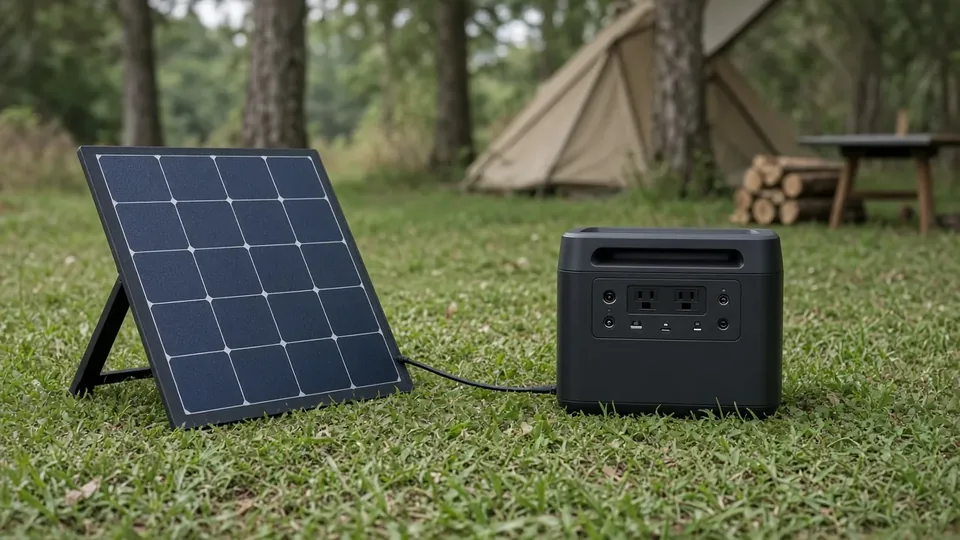
Applying the Panel × Peak Sun Hours × 0.75 Formula
The formula for calculating how much solar energy you can expect from your panels is:
Solar Wh per day = Panel W × Peak Sun Hours × 0.75
This accounts for real-world losses like dust, heat, and panel angle. The 0.75 factor is a standard efficiency loss estimate for most portable solar setups.
Let's break it down with an example:
- Panel W: 200 W
- Peak Sun Hours: 4.5 (see peak sun hours for your location)
- Efficiency Factor: 0.75
Calculation:
200 W × 4.5 h × 0.75 = 675 Wh per day
This means your 200 W panel can produce about 675 Wh of usable energy on a sunny day.
Matching Panel Watts to Daily Wh
To determine how many solar panels you need, first calculate your daily energy consumption. This is covered in detail in build an accurate weekend load list.
Once you know your daily load, you can match it to your solar setup. For example, if your daily load is 800 Wh and you live in an area with 4.5 peak sun hours, you'd need:
Panel W = Daily Wh ÷ (Peak Sun Hours × 0.75)
800 ÷ (4.5 × 0.75) = 237 W
So, a 250 W panel would be sufficient.
Portable Folding Panels Versus Fixed Arrays
For weekend use, portable folding panels are often more convenient than fixed arrays. Folding panels are lightweight, easy to transport, and can be set up quickly. They are ideal for campers, cabin owners, and seasonal users who need flexibility.
Fixed arrays, on the other hand, are more efficient and suitable for long-term use. They are typically used in permanent setups or for users who don't mind the installation effort.
For more details on types of panels, see folding, rigid, and blanket solar panels.
Charge-Controller and Input-Watt Limits
Your solar setup must also match the input watt limit of your power station. Most portable stations have a maximum solar input, such as 100 W, 200 W, or 300 W.
If your panels exceed this limit, you'll need a charge controller to regulate the input and prevent overcharging. Charge controllers are especially important when using multiple panels or high-wattage panels.
For example, if your power station has a 200 W input limit and you have a 300 W panel, you'll need a charge controller to manage the energy flow.
How Many Hours of Sun Do You Really Get?
Peak sun hours vary by location and season. Use peak sun hours to find the average for your area.
For example:
- Texas: 5.5 peak sun hours
- Washington State: 3.5 peak sun hours
- Alaska (summer): 6.5 peak sun hours
- Alaska (winter): 2.5 peak sun hours
These numbers help you size your solar setup for your specific conditions.
Over-Sizing Panels for Cloudy Weekends
If you live in an area with frequent cloud cover or unpredictable weather, it's wise to over-size your solar panels. This ensures you can still charge your battery even on cloudy days.
For example, if your daily load is 800 Wh and your area has 3 peak sun hours, you'd need:
Panel W = 800 ÷ (3 × 0.75) = 356 W
So, a 400 W panel would be a good choice to account for cloudy days.
Pairing Panels with Station Solar Input Ratings
Always check the maximum solar input rating of your power station. This is the highest wattage your station can accept from solar panels.
For example, if your station can take up to 200 W of solar input, you should not use more than that, even if you have a 300 W panel.
If you need more solar input, consider using multiple panels or a station with a higher solar input rating.
Worked Example
Example 1: Sizing Solar for a Weekend Cabin
Daily Load: 1,200 Wh
Location: Colorado (peak sun hours = 5.5)
Power Station Solar Input Limit: 200 W
Step 1: Calculate Required Panel Watts
Panel W = Daily Wh ÷ (Peak Sun Hours × 0.75)
Panel W = 1,200 ÷ (5.5 × 0.75) = 291 W
Step 2: Choose a Panel That Fits the Station's Input Limit
Since the station can only take 200 W of solar input, you'll need two 100 W panels to reach 200 W.
Step 3: Account for Efficiency and Cloudy Days
Even with two 100 W panels, you'll only get:
100 W × 5.5 h × 0.75 = 412 Wh per day
This is not enough to cover the 1,200 Wh load. To compensate, you'll need a station with a higher solar input rating, such as 300 W or more.
Example 2: Sizing Solar for a Weekend RV Trip
Daily Load: 600 Wh
Location: Washington State (peak sun hours = 3.5)
Power Station Solar Input Limit: 150 W
Step 1: Calculate Required Panel Watts
Panel W = Daily Wh ÷ (Peak Sun Hours × 0.75)
Panel W = 600 ÷ (3.5 × 0.75) = 228 W
Step 2: Choose a Panel That Fits the Station's Input Limit
Since the station can only take 150 W of solar input, you'll need one 150 W panel.
Step 3: Account for Efficiency and Cloudy Days
With one 150 W panel, you'll get:
150 W × 3.5 h × 0.75 = 394 Wh per day
This is not enough to cover the 600 Wh load. To compensate, you'll need a station with a higher solar input rating, such as 200 W or more.
Step-by-Step Guide to Sizing Solar Panels for a Weekend Power Station
- Calculate your daily energy consumption in watt-hours (Wh). This is the total power your devices use in a day.
- Find your location's peak sun hours using peak sun hours.
- Use the formula to calculate the required solar wattage:
Panel W = Daily Wh ÷ (Peak Sun Hours × 0.75) - Check your power station's maximum solar input rating. This is the highest wattage your station can accept from solar panels.
- Choose panels that match or are below your station's input limit.
- Account for efficiency and cloudy days by over-sizing your panels if needed.
Common Mistakes to Avoid
- Not accounting for efficiency losses: The 0.75 factor is essential. Skipping it will overestimate your solar output.
- Ignoring your power station's input limit: Using panels that exceed your station's input limit can damage the system.
- Underestimating daily load: Be sure to include all devices, even those used for short periods.
- Assuming one panel is enough: In many cases, especially in low-sun areas, multiple panels are needed.
- Not checking for peak sun hours: Using the wrong number for your location can lead to an undersized or oversized system.
FAQ
How many watts of solar do I need for 800 Wh a day?
Use the formula: Panel W = Daily Wh ÷ (Peak Sun Hours × 0.75). For example, in an area with 4.5 peak sun hours:
800 ÷ (4.5 × 0.75) = 237 W. A 250 W panel would be sufficient.
Does the 0.75 already cover heat and dirt losses?
Yes, the 0.75 factor in the formula is a standard efficiency loss estimate that includes heat, dust, and panel angle. It's a general-purpose number and may vary slightly depending on conditions.
Can one 100 W panel keep a small station topped up?
Yes, a 100 W panel can keep a small station topped up, especially in areas with high peak sun hours. However, it may take longer to charge and may not be enough for high daily loads.
What if I have multiple panels?
If you have multiple panels, add their wattages together and use the total in the formula. For example, two 100 W panels = 200 W.
What if I have a power station with a 300 W solar input limit?
You can use up to 300 W of solar input. If your daily load is 1,500 Wh and your area has 5 peak sun hours, you'd need:
Panel W = 1,500 ÷ (5 × 0.75) = 400 W. A 300 W station would not be sufficient, so you'd need a higher-capacity station.
Related Pages
- /how-to-size-off-grid-power-weekend
- /watt-hours-vs-watts-formulas
- /weekend-load-list-cabin-rv-camping
- /battery-wh-needed-weekend
- /runtime-hours-battery-wh
- /peak-sun-hours-us-solar-sizing
- /generator-surge-sizing-cabin-rv
- /cold-weather-battery-capacity
- /weekend-cabin-power-example
- /rv-weekend-power-sizing
- /tent-vs-car-camping-power
- /weekend-home-backup-sizing
- /power-station-vs-generator-cabin
- /500-1000-2000wh-weekend-comparison
- /solar-panel-types-weekend
- /charging-methods-weekend-station
- /lifepo4-vs-other-chemistries
- /efficiency-losses-weekend-power
- /buying-guide-weekend-power-station
- /battery-autonomy-days-weekend
- /expandable-battery-packs-weekend
- /expandable-vs-fixed-capacity-station
- /solar-only-vs-hybrid-weekend
- /cost-of-ownership-weekend-power
- /high-wattage-vs-high-capacity
- /summer-heat-seasonal-adjustments
- /buying-guide-solar-panels-weekend
- /full-worked-example-weekend-cabin
Sources to Cite
- SOURCE: National Renewable Energy Laboratory (NREL) - Peak Sun Hours Map
- SOURCE: U.S. Department of Energy - Solar Efficiency Losses
- SOURCE: Consumer Reports - Portable Solar Panel Reviews
Who This Is Not For
This guide is not for users who need full-time off-grid power, require high-wattage appliances, or need solar systems that integrate with home wiring. It's designed for weekend and seasonal users who want to avoid generators and keep their power needs manageable.
For full-time off-grid systems, see how to size off-grid power for a weekend. For users who need to connect to home wiring, always use a listed inlet and transfer switch installed by a licensed electrician.