Folding, Rigid, and Blanket Solar Panels for Weekend Systems
Updated 2026-10-21 · Published by Charland & Co. · Based on published specs; we have not tested the products discussed.
Quick answer: Folding solar panels are compact and easy to carry, rigid panels offer higher efficiency and durability, and blanket panels are lightweight and flexible. For a weekend cabin, a 100 W rigid panel with a 20% efficiency rating can generate about 375 Wh per day in 5 peak sun hours.
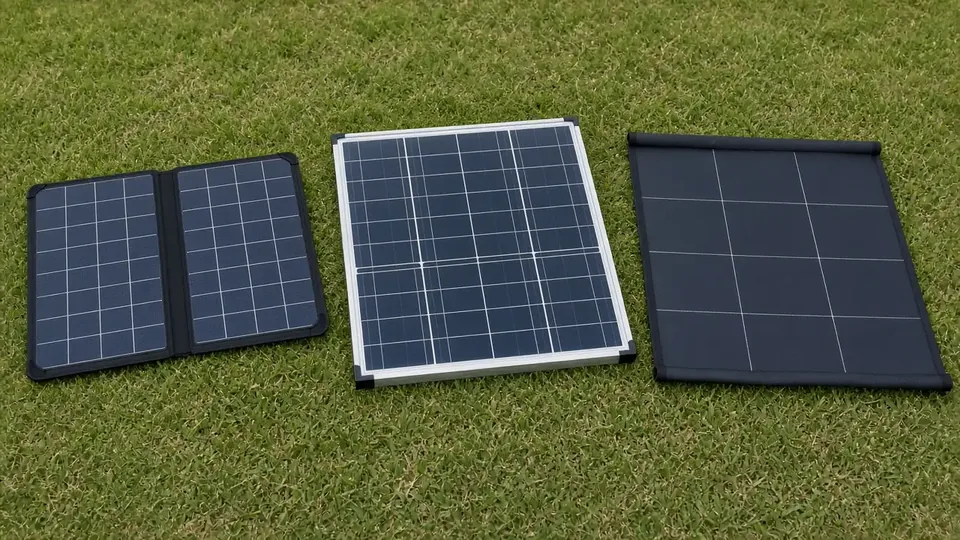
Choosing the right solar panel type for your weekend power system depends on your needs. Folding, rigid, and blanket panels each have strengths and weaknesses. Consider portability, efficiency, and space when making your choice.
Understanding the Three Main Types of Solar Panels
Folding Solar Panels
Folding panels are made for easy transport. They are lightweight and can be folded into a small package. Ideal for campers, van lifers, and weekenders who move their setup often.
Pros:
- Easy to carry and store.
- Often come with cases or bags.
- Work well in small spaces.
Cons:
- Lower efficiency than rigid panels.
- More fragile.
- Not as durable for long-term use.
Rigid Solar Panels
Rigid panels are the most common type. They are made with durable materials and are used in permanent or semi-permanent setups.
Pros:
- Higher efficiency and longer lifespan.
- More stable and less likely to break.
- Often have mounting options.
Cons:
- Heavier and bulkier.
- Less portable.
- Need more space for installation.
Blanket Solar Panels
Blanket panels are newer. They are lightweight and flexible, making them good for uneven or tight spaces.
Pros:
- Lightweight and flexible.
- Easy to transport and install.
- Work on a variety of surfaces.
Cons:
- Lower efficiency than rigid panels.
- May not last as long.
- Less available and more expensive.
Choosing the Right Type for Your Weekend System
Think about these factors when selecting panels:
1. Portability
If you move your setup often, folding or blanket panels are better. Rigid panels are better for fixed setups.
2. Efficiency
Rigid panels are the most efficient. Folding and blanket panels may need more space to generate the same power.
3. Durability
Rigid panels are the most durable. Folding and blanket panels may break more easily.
4. Space Constraints
If space is limited, folding or blanket panels may be better. Rigid panels need more room.
Step-by-Step Guide to Choosing Solar Panels for Your Weekend System
-
Determine Your Daily Energy Needs
- Calculate the total watt-hours (Wh) your system needs each day.
- Example: A 1,000 W load for 24 hours needs 24,000 Wh. -
Account for Efficiency Losses
- Use the site formula:
Solar Wh per day = Panel W x Peak Sun Hours x 0.75
- Example: 5 peak sun hours and 24,000 Wh needed:
24,000 Wh / (5 x 0.75) = 6,400 W of solar capacity -
Choose the Right Type of Panel
- For portability, pick folding or blanket panels.
- For efficiency and durability, pick rigid panels. -
Select the Right Panel Size and Number
- Use the site formula:
Number of panels = Required Solar W / Panel W
- Example: 6,400 W needed and 100 W rigid panel:
6,400 W / 100 W = 64 panels -
Consider Additional Factors
- Check for surge watt requirements if using high-power devices.
- Ensure your power station can handle the solar input and has a compatible charge controller.
Worked Example: Choosing Solar Panels for a Weekend Cabin
Example 1: Rigid Panel Setup
Scenario: You need to power a 1,000 W load for 24 hours at a remote cabin.
Step 1: Calculate Daily Energy Needs
- Load W = 1,000 W
- Runtime hours = 24
- Daily Wh = 1,000 W x 24 = 24,000 Wh
Step 2: Account for Efficiency Losses
- Solar Wh per day = 24,000 Wh / 0.75 = 32,000 Wh
Step 3: Determine Peak Sun Hours
- Peak sun hours = 5 (based on peak sun hours)
Step 4: Calculate Required Solar Capacity
- Panel W = 32,000 Wh / 5 = 6,400 W
Step 5: Choose Panel Type and Size
- Panel W = 100 W (rigid panel)
- Number of panels = 6,400 W / 100 W = 64 panels
Example 2: Folding Panel Setup
Scenario: You need to power a 500 W load for 12 hours while camping.
Step 1: Calculate Daily Energy Needs
- Load W = 500 W
- Runtime hours = 12
- Daily Wh = 500 W x 12 = 6,000 Wh
Step 2: Account for Efficiency Losses
- Solar Wh per day = 6,000 Wh / 0.75 = 8,000 Wh
Step 3: Determine Peak Sun Hours
- Peak sun hours = 4 (based on peak sun hours)
Step 4: Calculate Required Solar Capacity
- Panel W = 8,000 Wh / 4 = 2,000 W
Step 5: Choose Panel Type and Size
- Panel W = 150 W (folding panel)
- Number of panels = 2,000 W / 150 W = 13.3, round up to 14 panels (2,100 W)
Common Mistakes to Avoid
- Ignoring Efficiency Losses: Always use the 0.75 efficiency factor when calculating solar Wh per day.
- Overlooking Surge Watt Requirements: Some devices need more power to start than they use. Make sure your power station can handle this.
- Choosing the Wrong Panel Type: Picking a panel based only on price or size without considering efficiency and portability can lead to underperformance.
- Not Checking Peak Sun Hours: The amount of sunlight your location receives daily can significantly impact your solar setup's performance.
- Neglecting Charge Controller Compatibility: Ensure your power station has a compatible charge controller to prevent overcharging and damage.
Who This Is Not For
This guide is not for users who need a permanent or semi-permanent solar installation. It is also not for users who require high-efficiency solar panels for commercial or industrial use. If you are looking for a long-term, high-efficiency solar solution, you may want to consult a professional solar installer.
FAQ
What is the difference between folding and rigid solar panels?
Folding panels are more portable and compact, while rigid panels are more durable and efficient. Folding panels are ideal for frequent transport, while rigid panels are better for stationary or semi-permanent setups.
Are blanket solar panels worth it for weekend use?
Blanket panels are lightweight and flexible, making them ideal for use in tight spaces or on uneven surfaces. However, they are less efficient than rigid panels and may not be the best choice for high-power needs.
Can I use folding solar panels for a weekend cabin?
Yes, folding panels can be used for a weekend cabin, but they may not be as efficient as rigid panels. If you need to generate a lot of power quickly, rigid panels may be a better choice.
How do I choose the right solar panel for my weekend system?
Consider factors such as portability, efficiency, durability, and space constraints. If you need a portable solution, folding or blanket panels may be the best choice. If you need a more efficient and durable solution, rigid panels may be the best option.
What is the best way to charge a power station with solar panels?
The best way to charge a power station with solar panels is to use a high-efficiency panel and ensure that the panel is positioned to receive maximum sunlight. You should also use a charge controller to protect your power station from overcharging.
Related Pages
- p01: How to Size Off-Grid Power for a Weekend
- p07: Size Solar Panels for a Weekend Power Station
- p29: Buying Guide: Solar Panels for Weekend Power Stations
- p17: Wall, Car, and Solar Charging Options for Weekend Stations
Sources to Cite
- SOURCE: NREL: National Renewable Energy Laboratory (NREL) provides data on solar panel efficiency and peak sun hours.
- SOURCE: Energy.gov: U.S. Department of Energy provides information on solar panel types and efficiency.
- SOURCE: Solar Energy Industries Association (SEIA): SEIA provides information on solar panel types and efficiency.