Total Cost of Ownership for Weekend Power Systems
Updated 2026-10-21 · Published by Charland & Co. · Based on published specs; we have not tested the products discussed.
Quick answer: For a weekend load of about 1 kWh, a 1,024 Wh power station listed at $699 costs about $718 over five years of 20 weekends, while a 2,200 W inverter generator listed at $1,199 costs about $1,310 plus oil and service. Prices are maker list prices on 2026-10-21; check current prices.
Purchase Price
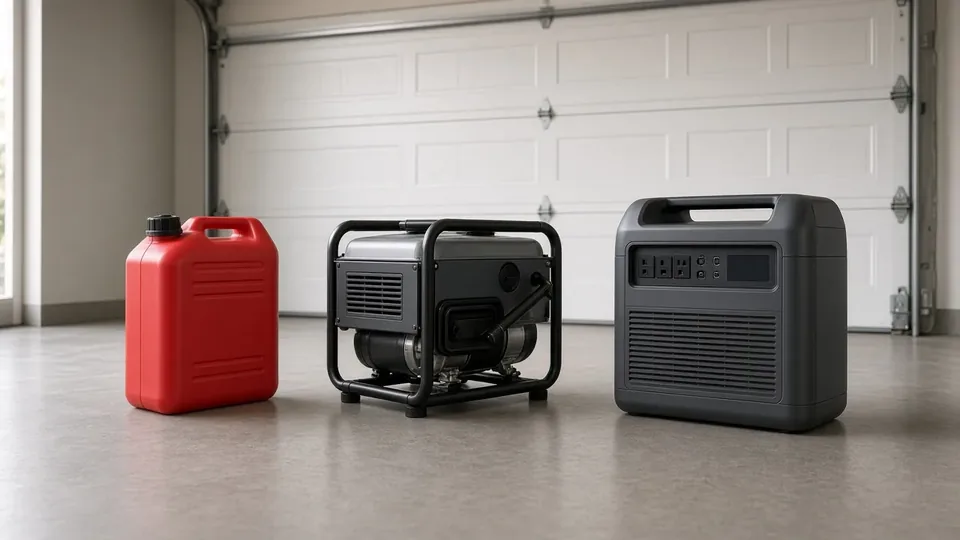
Prices change often, so we use real maker list prices instead of ranges. On 2026-10-21, the EcoFlow DELTA 3 (1,024 Wh, 1,800 W output) listed at $699 on EcoFlow's US store (source 1), and the Honda EU2200i (2,200 W max, 1,800 W rated) had an MSRP of $1,199 (source 2). Larger stations and generators cost more; compare current prices for the size you need.
Fuel and Maintenance for Generators
Honda lists the EU2200i tank at 0.95 gallons, running 3.2 hours at rated load and 8.1 hours at 1/4 load (source 2). That works out to 0.95 ÷ 3.2 = 0.30 gallons per hour at full load, and 0.95 ÷ 8.1 = 0.117 gallons per hour at 1/4 load.
The U.S. average price of regular gasoline was $4.284 per gallon in the week of 2026-10-19 (EIA, source 3). Use your local price.
Maintenance means oil changes, spark plugs and air filters on the schedule in the owner's manual. Costs depend on the model and who does the work, so add your own figure.
Electricity Cost to Recharge a Station
The U.S. average residential electricity price was 18.31 cents per kWh in July 2026 (EIA, source 4). One full recharge of a 1,024 Wh station is about 1.024 × 0.1831 = 0.19 dollars, before charger losses. Your rate may be higher or lower.
Cycle-Life Amortization
EcoFlow rates the DELTA 3 at 4,000 cycles to 80% capacity (source 1). One recharge per weekend for 20 weekends a year is 100 cycles a year, so 4,000 ÷ 100 = 40 years of rated cycles. In practice, age and storage conditions are more likely to limit the battery than cycle count. Check the maker's rating for the station you buy.
Solar Panel Added Cost and Harvest Value
A solar panel adds upfront cost but cuts recharge cost. A 100 W panel in 5 peak sun hours makes at most 100 × 5 = 500 Wh per day before losses. Check peak sun hours for your site with NREL PVWatts (source 5) and current panel prices before you count the savings.
Five-Year Ownership Example (about 1 kWh per weekend)
This example uses the two models above for a load the station can cover: about 1 kWh per weekend, 20 weekends a year, for 5 years.
Generator (Honda EU2200i)
- Purchase price: $1,199 (MSRP, source 2)
- Run time for 1 kWh at 1/4 load (450 W): 1,000 ÷ 450 = 2.2 hours
- Fuel per weekend: 0.117 × 2.2 = 0.26 gallons; 0.26 × 4.284 = $1.11
- Fuel over 5 years: 1.11 × 20 × 5 = 111
- Total before maintenance: 1,199 + 111 = 1,310, plus oil and service from the owner's manual
Portable Power Station (EcoFlow DELTA 3, 1,024 Wh)
- Purchase price: $699 (list, source 1)
- Recharge per weekend: 1.024 × 0.1831 = 0.19
- Recharge over 5 years: 0.19 × 20 × 5 = 19
- Total over 5 years: 699 + 19 = 718
With these two models, the station costs less up front and to run. For loads above what one station holds, add expansion batteries or a larger station, and run the same math with current prices.
Step-by-Step Guide to Calculating Total Cost of Ownership
-
Determine your power needs: List all the devices you plan to power and their wattage. For example, a mini-fridge might use 100 W, a microwave 1,200 W, and lights 100 W.
-
Estimate usage time: How long will each device be used per weekend? For example, the fridge might run 24 hours, the microwave 1 hour, and lights 4 hours.
-
Calculate daily watt-hours (Wh): Multiply each device's wattage by its usage time. For example: - Fridge: 100 W × 24 h = 2,400 Wh - Microwave: 1,200 W × 1 h = 1,200 Wh - Lights: 100 W × 4 h = 400 Wh - Total daily Wh: 2,400 + 1,200 + 400 = 4,000 Wh
-
Account for inverter losses: The 1.2 buffer in the next step covers inverter loss (about 15%) and a safety margin, so do not shrink the total here.
-
Determine battery capacity needed: Multiply daily Wh by the number of days you need power (e.g., 1 weekend = 1 day) and by 1.2 (for safety margin). 4,000 Wh × 1 × 1.2 = 4,800 Wh
-
Choose a power station: Select a station with at least 4,800 Wh capacity. A 5,000 Wh station (or a 2,000 Wh station plus expansion batteries) fits.
-
Calculate recharge cost: At the U.S. average residential rate of 18.31 cents per kWh (EIA, July 2026), recharging a 5,000 Wh station costs about 5 kWh × $0.1831 = $0.92. Use the rate on your own bill.
-
Estimate generator costs: Use the fuel figures from the generator's spec sheet and your local fuel price, as in the five-year example above.
-
Compare total costs: Add purchase price, five years of fuel or electricity, and the maintenance listed in the generator's owner's manual. Check current prices before you buy; they change often.
Common Mistakes to Avoid
-
Ignoring inverter efficiency: Always multiply your total watt-hours by 0.85 to account for inverter losses.
-
Underestimating generator fuel costs: Fuel costs can vary widely by region and should be factored in accurately.
-
Overlooking maintenance costs: Regular maintenance is essential for generators and can add up over time.
-
Not accounting for cold-weather performance: Battery capacity can drop by up to 15% in cold weather, so choose a station with a higher capacity if you use it in cold climates.
-
Assuming solar is always free: Solar panels require an upfront investment and may not be practical in all locations.
FAQ
How many weekends until a station costs less than a generator?
It depends on the two prices and your fuel use. Divide the price difference by the fuel saved per weekend. In our example, the station is cheaper up front, so it never needs to pay back.
What is a realistic annual fuel cost for weekend generator use?
Work it out from the spec sheet. For example, an EU2200i running 2.2 hours per weekend at 1/4 load uses about $1.11 of fuel at $4.284 per gallon, so 1.11 × 20 = 22.2 dollars for 20 weekends. Longer runs or heavier loads cost more.
Does solar shorten the payback period?
Yes, solar can shorten the payback period by reducing the need to recharge the power station using electricity. If you use solar to recharge the station, you might only need to recharge it once every few weekends, which can significantly reduce the electricity cost.
Can I use a portable power station for continuous power?
No, portable power stations are not designed for continuous use. They are best suited for short-term, intermittent use such as weekend trips or seasonal stays.
What is the best way to size a power station for weekend use?
Use the formula: battery Wh needed = daily Wh x days x 1.2. List all your devices, calculate their watt-hours, and multiply by the number of days you need power, then add a 20% safety margin.
Related Pages
- p01 - How to Size Off-Grid Power for a Weekend
- p04 - How Much Battery Capacity Do You Need for a Weekend
- p05 - Calculate Runtime Hours from Any Power Station
- p07 - Size Solar Panels for a Weekend Power Station
- p14 - Portable Power Station Versus Gas Generator for Weekend Cabins
- p25 - Solar-Only Weekend Systems Versus Solar-Plus-Generator Hybrids
Sources
- EcoFlow DELTA 3 product page (capacity, output, cycle life, list price, 2026-10-21): https://us.ecoflow.com/products/delta-2-portable-power-station
- Honda EU2200i specifications and MSRP: https://powerequipment.honda.com/generators/models/eu2200i
- U.S. EIA, Gasoline and Diesel Fuel Update (week of 2026-10-19): https://www.eia.gov/petroleum/gasdiesel/
- U.S. EIA, Electric Power Monthly Table 5.6.A (July 2026 residential average): https://www.eia.gov/electricity/monthly/epm_table_grapher.php?t=epmt_5_6_a
- NREL PVWatts calculator: https://pvwatts.nrel.gov/
Who This Is Not For
This page is not for readers who need continuous power for extended periods, such as full-time RVers or those living off-grid. It's also not for those who require high-power tools or appliances that exceed the capacity of a portable power station. If you need a backup power solution for your home, consult a licensed electrician and consider a whole-home generator or battery backup system.