Weekend Home-Backup Loads You Can Cover with a Portable Station
Updated 2026-10-21 · Published by Charland & Co. · Based on published specs; we have not tested the products discussed.
Quick answer: A portable power station with at least 1,200-1,400 Wh can cover a fridge (80-100 W), lights, router, and phone charging for 12 hours. Add 20% for losses and 10% for cold weather, aiming for 1,600-1,800 Wh.
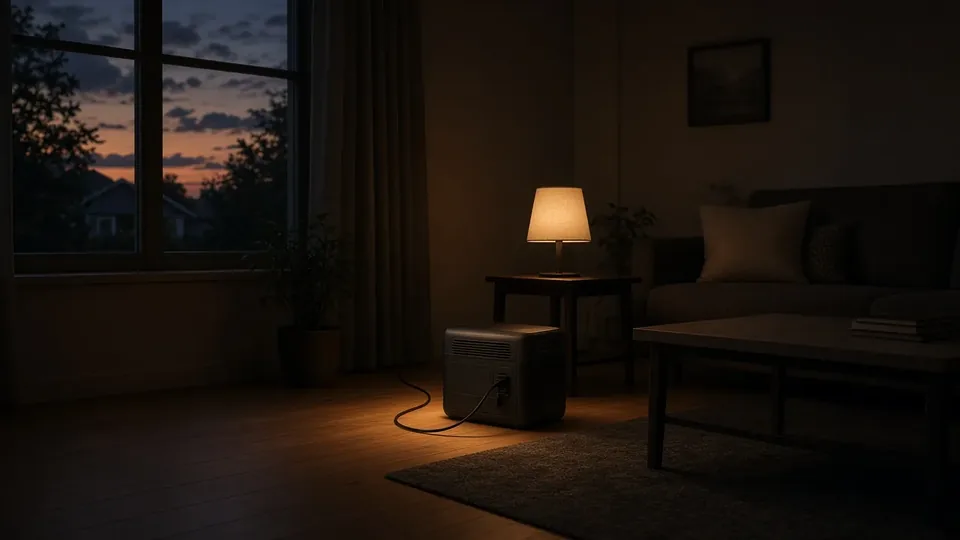
When a power outage hits your home, a portable power station can be a lifeline. Whether you're preparing for a storm, a blackout, or simply want to be ready for emergencies, knowing which loads your portable power station can cover is essential. This page helps you understand the key appliances and devices you can power during a weekend home backup, and how to size your portable power station accordingly.
Understanding Your Weekend Home Backup Needs
A weekend home backup typically involves powering essential appliances and devices for a short period — usually 12 to 24 hours. Unlike full-time off-grid living, weekend backups are more about maintaining comfort and safety during a power outage. The goal is to cover critical loads such as lighting, refrigeration, communication, and basic cooking.
Key Loads to Consider
Here are the most common loads you might want to power during a weekend home backup:
- Refrigerator or freezer: 80-100 W, but may require more power during startup.
- Lights: 50-100 W total, depending on the number of bulbs and type (LED vs. incandescent).
- Router or Wi-Fi modem: 10-20 W.
- Phone chargers: 5-10 W per device.
- TV or media player: 50-100 W.
- Small fan or space heater: 50-100 W.
- Coffee maker or kettle: 500-1,000 W (but only for short periods).
- Laptop or desktop computer: 50-150 W.
- Small microwave: 500-1,000 W (again, short use only).
These are just a few examples. The exact loads will depend on your home and how you use it during a power outage.
How to Size Your Portable Power Station
To determine the right size of a portable power station for your weekend home backup, you need to calculate the total energy required for the loads you want to power. This involves three main steps:
- List your essential loads and their power consumption (in watts).
- Estimate how long you'll need each load to run (in hours).
- Multiply the power (in watts) by the time (in hours) to get the energy required (in watt-hours, or Wh).
Once you have the total energy required, you should add a buffer for efficiency losses and cold-weather performance. A common rule of thumb is to multiply the total energy by 1.2 for losses and by 0.85 for cold-weather performance, resulting in a final multiplier of 0.72 (1.2 × 0.85).
Example Calculation
Let's say you want to power the following during a 12-hour weekend backup:
- Refrigerator: 100 W × 12 h = 1,200 Wh
- Lights: 50 W × 12 h = 600 Wh
- Router: 15 W × 12 h = 180 Wh
- Phone chargers: 10 W × 12 h = 120 Wh
Total energy needed (before losses):
1,200 + 600 + 180 + 120 = 2,100 Wh
Add 20% for losses:
2,100 × 1.2 = 2,520 Wh
Add 10% for cold-weather performance:
2,520 × 0.85 = 2,142 Wh
So, you'd need a portable power station with at least 2,142 Wh of battery capacity to cover these loads for 12 hours during a weekend backup.
Worked Example
Let's walk through a real-world example to make this more concrete.
Scenario
You live in a home with the following essential loads:
- Refrigerator: 90 W (with a 200 W surge during startup)
- Lights: 60 W (LED bulbs)
- Router: 20 W
- Phone chargers: 10 W (for two devices)
- TV: 80 W (used for 4 hours)
- Laptop: 60 W (used for 4 hours)
You want to power these for 12 hours, but the TV and laptop will only be used for 4 hours each.
Step-by-Step Calculation
- Refrigerator: 90 W × 12 h = 1,080 Wh
- Lights: 60 W × 12 h = 720 Wh
- Router: 20 W × 12 h = 240 Wh
- Phone chargers: 10 W × 12 h = 120 Wh
- TV: 80 W × 4 h = 320 Wh
- Laptop: 60 W × 4 h = 240 Wh
Total energy needed (before losses):
1,080 + 720 + 240 + 120 + 320 + 240 = 2,720 Wh
Add 20% for losses:
2,720 × 1.2 = 3,264 Wh
Add 10% for cold-weather performance:
3,264 × 0.85 = 2,774 Wh
So, you'd need a portable power station with at least 2,774 Wh of battery capacity to cover these loads for 12 hours during a weekend backup.
Worked Example 2
Let's take another example with different numbers to show how the formulas apply in a different context.
Scenario
You want to power the following during a 24-hour weekend backup:
- Refrigerator: 100 W (with a 250 W surge)
- Lights: 70 W
- Router: 25 W
- Phone chargers: 15 W (for three devices)
- TV: 100 W (used for 6 hours)
- Laptop: 80 W (used for 6 hours)
- Space heater: 1,000 W (used for 2 hours)
Step-by-Step Calculation
- Refrigerator: 100 W × 24 h = 2,400 Wh
- Lights: 70 W × 24 h = 1,680 Wh
- Router: 25 W × 24 h = 600 Wh
- Phone chargers: 15 W × 24 h = 360 Wh
- TV: 100 W × 6 h = 600 Wh
- Laptop: 80 W × 6 h = 480 Wh
- Space heater: 1,000 W × 2 h = 2,000 Wh
Total energy needed (before losses):
2,400 + 1,680 + 600 + 360 + 600 + 480 + 2,000 = 8,120 Wh
Add 20% for losses:
8,120 × 1.2 = 9,744 Wh
Cold room check: a battery in a cold room gives about 85% of its rating, so divide by 0.85:
9,744 ÷ 0.85 = 11,464 Wh
So, you'd need a portable power station with about 9,744 Wh of rated capacity (about 11,464 Wh if it sits in a cold room) to cover these loads for 24 hours during a weekend backup.
Step-by-Step Guide to Sizing Your Portable Power Station
Here's a clear, step-by-step guide to help you size your portable power station for a weekend home backup:
-
List all essential loads: Identify the appliances and devices you want to power during a power outage. This includes things like the refrigerator, lights, router, phone chargers, TV, laptop, and any other essential items.
-
Determine the power consumption (in watts): For each load, find out how much power it uses. This information is usually listed on the device itself or in the user manual.
-
Estimate the runtime (in hours): Decide how long you want each load to run. For example, you might want the refrigerator to run for 24 hours, but the TV only for 6 hours.
-
Calculate the energy required (in watt-hours): Multiply the power (in watts) by the runtime (in hours) for each load. This gives you the energy required for each load.
-
Add up the total energy required: Sum the watt-hours for all the loads to get the total energy needed for the weekend backup.
-
Add a buffer for losses: Multiply the total energy by 1.2 to account for efficiency losses in the power station.
-
Adjust for cold-weather performance: Multiply the result by 0.85 to account for reduced battery performance in cold weather.
-
Choose a portable power station with sufficient capacity: Look for a station with a battery capacity that is at least equal to the final number you calculated.
Common Mistakes to Avoid
When sizing your portable power station, it's easy to make a few common mistakes. Here are some of the most common ones and how to avoid them:
- Forgetting about surge power: Many appliances, like refrigerators and air conditioners, require a surge of power during startup. Make sure to account for this in your calculations.
- Not considering cold-weather performance: Battery capacity can drop significantly in cold weather. Always adjust your calculations to account for this.
- Underestimating the runtime: It's easy to underestimate how long you'll need each load to run. Be sure to plan for the worst-case scenario.
- Ignoring efficiency losses: Portable power stations are not 100% efficient. Always add a buffer for losses in your calculations.
- Not checking the inverter capacity: The inverter capacity of the power station must be sufficient to handle the total power draw of all your loads at once.
Choosing the Right Portable Power Station
When selecting a portable power station for weekend home backup, look for the following features:
- Battery capacity (Wh): At least 2,500-3,000 Wh for most weekend home backups.
- Continuous power output (W): At least 1,500 W for most appliances.
- Surge power (W): At least 2,500 W to handle startup surges from appliances like refrigerators.
- Inverter efficiency: Look for stations with inverter efficiency of 85% or higher.
- Portability: Choose a station that is easy to move and store.
- Solar compatibility: If you plan to recharge your station with solar panels, look for models with solar input ports.
- Battery chemistry: LiFePO4 batteries are preferred for their longevity and performance in cold weather.
Safety Considerations
Never backfeed a house outlet with a portable power station. Doing so can be extremely dangerous and may damage your home's electrical system or even cause a fire. If you want to connect your portable power station to your home's electrical system, you must use a listed inlet and transfer switch installed by a licensed electrician per local code.
Fuel generators must always be used outdoors, far from doors, windows, and any source of ignition. Never use a fuel generator indoors, even if it's labeled as "carbon monoxide-free."
FAQ
How long will a 2,000 Wh portable power station last?
It depends on the load. For example, a 2,000 Wh station can power a 100 W fridge for about 16 hours (2,000 / 100 = 20, but with losses, it's closer to 16 hours). For higher loads, the runtime will be shorter.
Can I use a portable power station to power my whole house?
No, not for long. Portable power stations are designed for short-term use and cannot power an entire house for extended periods. They are best suited for essential loads during a power outage.
What is the difference between a portable power station and a generator?
A portable power station is a battery-powered device that runs silently and emits no emissions. A generator is a fuel-powered device that is louder and emits fumes. Generators are better for long-term use, while power stations are better for short-term, quiet backup.
Can I use solar panels to recharge my portable power station?
Yes, many portable power stations have solar input ports. You can use solar panels to recharge your station during the day, which is especially useful for weekend backups.
What is the best battery chemistry for a portable power station?
LiFePO4 (lithium iron phosphate) is the best battery chemistry for portable power stations due to its long lifespan, safety, and performance in cold weather.
Related Pages
- p01: How to Size Off-Grid Power for a Weekend
- p04: How Much Battery Capacity Do You Need for a Weekend
- p05: Calculate Runtime Hours from Any Power Station
- p09: Cold-Weather Capacity Loss for Weekend Power Stations
- p15: 500 Wh Versus 1,000 Wh Versus 2,000 Wh Stations for Weekends
- p20: Buying Guide: Choosing a Portable Power Station for Weekend Use
Sources to Cite
- SOURCE: U.S. Department of Energy - Energy Efficiency and Renewable Energy
- SOURCE: National Electrical Code (NEC) - Article 705
- SOURCE: Consumer Product Safety Commission (CPSC) - Generator Safety
- SOURCE: Centers for Disease Control and Prevention (CDC) - Carbon Monoxide Poisoning
Who This Is Not For
This page is not for full-time off-grid living, long-term power outages, or powering high-wattage appliances like air conditioners or electric stoves. It is specifically for weekend home backups and short-term power outages. If you need power for more than a few days or for high-wattage appliances, you'll need a larger system or a fuel generator.