500 Wh Versus 1,000 Wh Versus 2,000 Wh Stations for Weekends
Updated 2026-10-21 · Published by Charland & Co. · Based on published specs; we have not tested the products discussed.
Quick answer: A 500 Wh station can power a weekend with ~180 Wh/day use, a 1,000 Wh station with ~400 Wh/day use, and a 2,000 Wh station with ~800 Wh/day use. Choose based on your load list and how long you need power to last.
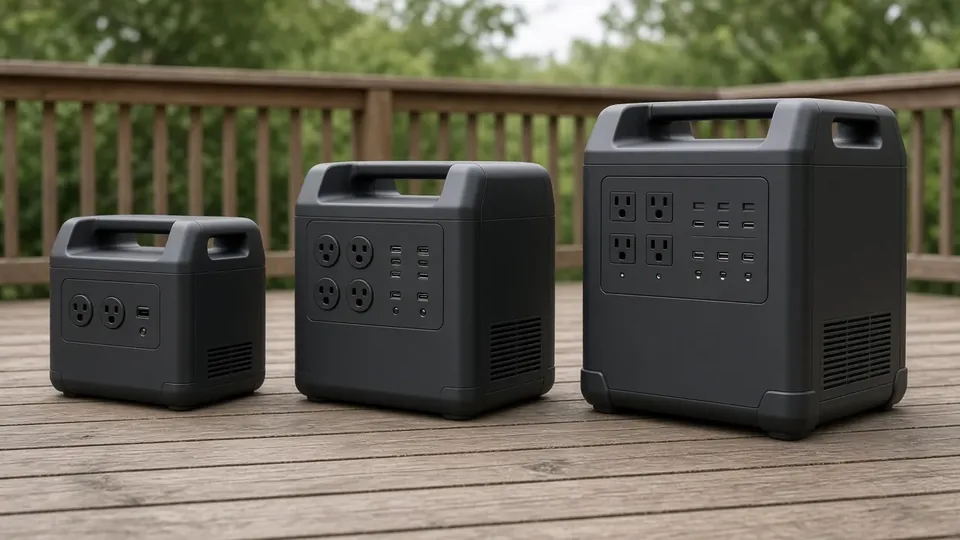
When choosing a portable power station for weekend use, the size of the battery — measured in watt-hours (Wh) — is one of the most important factors. A 500 Wh station is best for very light use, a 1,000 Wh station for moderate use, and a 2,000 Wh station for heavier or longer use. This page compares the three sizes, shows how to calculate what each can do, and helps you pick the right one for your needs.
Understanding Battery Size and Weekend Use
Battery size determines how long your power station can run your devices. The key formula to use is:
Battery Wh needed = daily Wh x days x 1.2
This accounts for inefficiencies and unexpected use. For example, if you need 900 Wh over two days, the calculation becomes:
900 x 2 x 1.2 = 2,160 Wh, which is more than a 2,000 Wh station can provide. So, for a 2,000 Wh station, you'd need to aim for a daily use of around 800 Wh to stay within its capacity.
Similarly, for a 500 Wh station, the calculation would be:
200 x 2 x 1.2 = 480 Wh, which means a daily use of around 180 Wh is a better target.
This shows that the size of your power station directly affects how much you can use it for. Let's break this down further.
What Each Size Can Do
500 Wh Station
A 500 Wh station is best for very light weekend use. It can power small devices like LED lights, phone chargers, and small fans. It's not suitable for larger appliances like fridges, air conditioners, or space heaters.
Example use: - LED lights (10 W x 10 hours = 100 Wh) - Phone chargers (10 W x 5 hours = 50 Wh) - Small fan (15 W x 5 hours = 75 Wh)
Total: ~180 Wh/day (with some margin for inefficiency and unexpected use).
1,000 Wh Station
A 1,000 Wh station is suitable for moderate weekend use. It can power small appliances like a mini-fridge, a coffee maker, and a few lights. It's ideal for short trips or for people who want to power a few devices for a few hours each day.
Example use: - Mini-fridge (100 W x 6 hours = 600 Wh) - Coffee maker (1,000 W x 0.5 hours = 500 Wh) - LED lights (10 W x 10 hours = 100 Wh)
Total: ~400 Wh/day (with some margin for inefficiency and unexpected use).
2,000 Wh Station
A 2,000 Wh station is ideal for heavier weekend use. It can power larger appliances like a full-sized fridge, a microwave, and multiple lights. It's also good for longer trips or for people who want to power their cabin or RV for several days.
Example use: - Full-sized fridge (150 W x 8 hours = 1,200 Wh) - Microwave (1,000 W x 1 hour = 1,000 Wh) - LED lights (10 W x 10 hours = 100 Wh)
Total: ~800 Wh/day (with some margin for inefficiency and unexpected use).
Choosing the Right Size for Your Needs
To choose the right size, start by building an accurate load list. This means listing all the devices you plan to use and how long you'll use them each day. You can use our load list guide to help with this.
Once you have your load list, calculate your daily watt-hour use. Then multiply that by the number of days you'll be off-grid and by 1.2 to account for inefficiencies. This will give you the battery size you need.
For example, if you use 200 Wh/day for two days, the calculation is:
200 x 2 x 1.2 = 480 Wh, which means a 500 Wh station is a good fit.
If you use 400 Wh/day for two days, the calculation is:
400 x 2 x 1.2 = 960 Wh, which means a 1,000 Wh station is a good fit.
If you use 800 Wh/day for two days, the calculation is:
800 x 2 x 1.2 = 1,920 Wh, which means a 2,000 Wh station is a good fit.
Worked Example
Scenario: Weekend Cabin Stay
You plan to spend two days in a cabin. Your load list includes:
- LED lights: 10 W x 10 hours = 100 Wh
- Phone chargers: 10 W x 5 hours = 50 Wh
- Small fan: 15 W x 5 hours = 75 Wh
- Mini-fridge: 100 W x 6 hours = 600 Wh
Total daily use: 100 + 50 + 75 + 600 = 825 Wh
Battery Wh needed = 825 x 2 x 1.2 = 1,980 Wh
This means a 2,000 Wh station is the best fit for this scenario.
Worked Example 2: RV Boondocking
Scenario: Two-Day RV Boondocking Trip
You're planning a two-day trip in your RV and want to power the following:
- LED lights: 15 W x 12 hours = 180 Wh
- Coffee maker: 1,200 W x 0.5 hours = 600 Wh
- Water pump: 100 W x 2 hours = 200 Wh
- Phone chargers: 10 W x 6 hours = 60 Wh
- Electric kettle: 1,500 W x 0.3 hours = 450 Wh
Total daily use: 180 + 600 + 200 + 60 + 450 = 1,490 Wh
Battery Wh needed = 1,490 x 2 x 1.2 = 3,576 Wh
This means a 4,000 Wh station is the best fit for this scenario.
Step-by-Step Guide to Choosing the Right Power Station
- List all the devices you plan to use. Include every appliance, light, and charger.
- Estimate the power consumption of each device. Use the formula: Wh = W x hours.
- Calculate your total daily watt-hour use. Add up all the watt-hours from your devices.
- Multiply by the number of days you'll be off-grid. This gives you the total watt-hours needed for the trip.
- Multiply by 1.2 to account for inefficiencies. This gives you the battery size you need.
- Choose a power station with a capacity that matches or exceeds your calculated need. Ensure it has enough continuous power output to handle your devices at the same time.
Common Mistakes to Avoid
- Not accounting for inefficiencies. Always multiply your total watt-hours by 1.2 to ensure you have enough capacity.
- Ignoring surge power. Some devices, like fridges or air conditioners, require more power to start than they use to run. Make sure your power station can handle the surge.
- Overestimating the capacity of a power station. A 2,000 Wh station can't power a 2,000 W device for an hour — it can only power a 2,000 W device for about 1 hour if it has a 100% efficient inverter. In reality, it's less due to losses.
- Using the same power station for all trips. Different trips have different needs. Always tailor your choice to the specific use case.
What to Look for in a Power Station
When choosing a power station, consider the following:
- Battery capacity (Wh): This determines how long your station can run your devices.
- Continuous power output (W): This determines how many devices you can run at the same time.
- Surge power (W): This determines if your station can handle the startup power of devices like fridges or air conditioners.
- Solar charging capability: This determines if you can recharge your station using solar panels.
- Weight and portability: This determines how easy it is to carry your station.
- Battery chemistry: LiFePO4 batteries are more efficient and have longer lifespans than other types.
- Expandability: Some stations allow you to add more batteries for longer use.
Who This Is Not For
This page is not for people who need power for more than a few days, or for those who need to run high-power appliances like air conditioners or electric heaters. It's also not for people who need to power their entire home or who are looking for a permanent off-grid solution.
FAQ
What is the difference between a 500 Wh and a 1,000 Wh station?
A 500 Wh station can power very small devices for short periods, while a 1,000 Wh station can power small appliances for longer periods.
Can a 2,000 Wh station power a fridge?
Yes, a 2,000 Wh station can power a small fridge for a couple of days, depending on the fridge's power consumption and how long it runs.
How do I calculate how much battery I need?
Use the formula: Battery Wh needed = daily Wh x days x 1.2. This accounts for inefficiencies and unexpected use.
What is the best power station for a weekend cabin stay?
A 2,000 Wh station is ideal for a weekend cabin stay, as it can power a small fridge, lights, and other devices for two days.
Can I use solar panels with a power station?
Yes, many power stations support solar charging. You can size your solar panels using the formula: Solar Wh per day = panel W x peak sun hours x 0.75.
Related Pages
- p01: How to Size Off-Grid Power for a Weekend
- p04: How Much Battery Capacity Do You Need for a Weekend
- p05: Calculate Runtime Hours from Any Power Station
- p07: Size Solar Panels for a Weekend Power Station
- p10: Worked Load and Capacity Example for a Typical Weekend Cabin
- p20: Buying Guide: Choosing a Portable Power Station for Weekend Use