Wall, Car, and Solar Charging Options for Weekend Stations
Updated 2026-10-21 · Published by Charland & Co. · Based on published specs; we have not tested the products discussed.
Quick answer: A 1,000 Wh power station can be charged from a wall outlet in about 4 hours, from a car in 6-8 hours, and from a 100 W solar panel in about 10 hours of peak sun. All times vary by model and conditions.
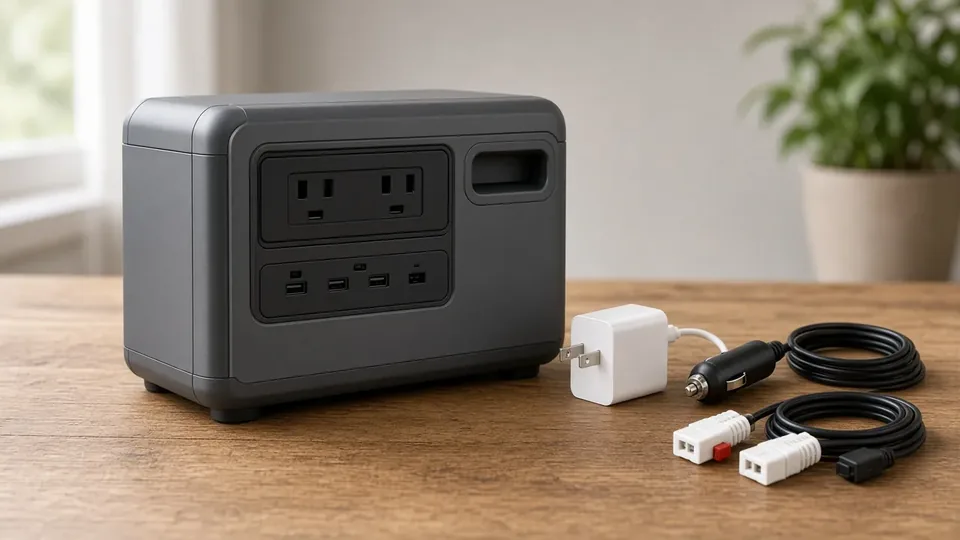
When you're using a portable power station for weekend trips, knowing how to charge it efficiently is just as important as knowing how much battery you need. Whether you're charging from a wall outlet, your car, or solar panels, each method has its own pros and cons. This page walks you through the options and gives you a checklist to help you choose the right setup for your needs.
Wall Charging
Wall charging is the most straightforward and fastest method for recharging your portable power station. Most modern stations support wall charging via a standard 120 V AC outlet. However, the time it takes to recharge depends on the power station's capacity and the wall charger's output.
What to Look For
- Charging speed: Look for a station with a fast wall charger, ideally 1,000 W or more. This can cut charging times in half compared to a standard 100-200 W charger.
- Compatibility: Ensure the wall charger is compatible with your power station model. Some stations require a specific wall adapter.
- Safety features: Look for overcharge protection, temperature control, and surge protection to keep your station safe during charging.
Step-by-Step Guide to Wall Charging
-
Identify your power station's capacity in watt-hours (Wh).
Example: 1,000 Wh. -
Find the wattage (W) of your wall charger.
Example: 250 W. -
Apply the wall charging formula:
Time (hours) = (Battery Wh × 0.85) ÷ (Charger W)
- Plug in the numbers:
Time (hours) = (1000 × 0.85) ÷ (250) = (850) ÷ (250) = 3.4 hours
- Interpret the result:
A 1,000 Wh power station can be charged in about 3.4 hours with a 250 W wall charger.
Example
If you have a 1,000 Wh power station and a 250 W wall charger, the time to recharge is:
Time (hours) = (1000 × 0.85) ÷ (250) = (850) ÷ (250) = 3.4 hours
This is a rough estimate and assumes ideal conditions. Actual times may vary based on the efficiency of the charger and the power station.
Car Charging
Car charging is a convenient option when you're on the road or at a campsite with access to a vehicle. Most portable power stations support car charging via a 12 V DC port. However, the charging speed is generally slower than wall charging.
What to Look For
- Car charger compatibility: Ensure your power station has a 12 V DC input port and that the car charger is compatible with your model.
- Charging speed: Car chargers typically range from 50 W to 150 W. A higher wattage charger will reduce charging time.
- Cable length and durability: Choose a car charger with a long, durable cable that can withstand outdoor conditions.
Step-by-Step Guide to Car Charging
-
Identify your power station's capacity in watt-hours (Wh).
Example: 1,000 Wh. -
Find the wattage (W) of your car charger.
Example: 100 W. -
Apply the car charging formula:
Time (hours) = (Battery Wh × 0.85) ÷ (Charger W)
- Plug in the numbers:
Time (hours) = (1000 × 0.85) ÷ (100) = (850) ÷ (100) = 8.5 hours
- Interpret the result:
A 1,000 Wh power station can be charged in about 8.5 hours with a 100 W car charger.
Example
If you have a 1,000 Wh power station and a 100 W car charger, the time to recharge is:
Time (hours) = (1000 × 0.85) ÷ (100) = (850) ÷ (100) = 8.5 hours
Again, this is a rough estimate and actual times may vary based on the efficiency of the charger and the power station.
Solar Charging
Solar charging is a great option for off-grid trips, but it requires careful planning to ensure you have enough capacity to recharge your power station. The time it takes to recharge depends on the size of your solar panel, the amount of sunlight you receive, and the efficiency of the solar setup.
What to Look For
- Solar panel size: Larger solar panels will charge your power station faster. A 100 W panel is a good starting point for most weekend trips.
- Peak sun hours: The number of peak sun hours in your area affects how much energy your solar panel can generate. You can find peak sun hours for your location using the peak sun hours map.
- Efficiency: Look for solar panels with high efficiency ratings (typically 20% or more) and a good inverter to convert DC to AC power.
Step-by-Step Guide to Solar Charging
-
Identify your power station's capacity in watt-hours (Wh).
Example: 1,000 Wh. -
Find the wattage (W) of your solar panel.
Example: 100 W. -
Find the number of peak sun hours in your area.
Example: 5 hours. -
Apply the solar charging formula:
Solar Wh per day = Panel W × Peak sun hours × 0.75
- Plug in the numbers:
Solar Wh per day = 100 × 5 × 0.75 = 375 Wh
- Calculate the number of days to recharge:
Days to recharge = (Battery Wh) ÷ (Solar Wh per day) = (1000) ÷ (375) ≈ 2.7 days
- Interpret the result:
A 1,000 Wh power station can be recharged in about 2.7 days with a 100 W solar panel and 5 peak sun hours.
Example
If you have a 1,000 Wh power station and a 100 W solar panel, and you receive 5 peak sun hours per day, the energy generated per day is:
Solar Wh per day = 100 × 5 × 0.75 = 375 Wh
To fully recharge the 1,000 Wh power station, you would need:
Days to recharge = (1000) ÷ (375) ≈ 2.7 days
This is a rough estimate and actual times may vary based on the efficiency of the solar setup and the power station.
Worked Example 1
Let's say you're planning a weekend trip and you have a 1,000 Wh power station. You want to know how long it will take to recharge using different methods.
Wall Charging
- Power station capacity: 1,000 Wh
- Wall charger output: 250 W
- Time to recharge:
(1000 × 0.85) ÷ (250) = (850) ÷ (250) = 3.4 hours
Car Charging
- Power station capacity: 1,000 Wh
- Car charger output: 100 W
- Time to recharge:
(1000 × 0.85) ÷ (100) = (850) ÷ (100) = 8.5 hours
Solar Charging
- Power station capacity: 1,000 Wh
- Solar panel size: 100 W
- Peak sun hours: 5
- Energy generated per day:
100 × 5 × 0.75 = 375 Wh
- Days to recharge:
(1000) ÷ (375) ≈ 2.7 days
This example shows that wall charging is the fastest method, followed by car charging, and solar charging is the slowest. However, solar charging is a great option for off-grid trips where access to wall outlets or cars is limited.
Worked Example 2
Let's say you're planning a longer trip and you have a 2,000 Wh power station. You want to know how long it will take to recharge using different methods.
Wall Charging
- Power station capacity: 2,000 Wh
- Wall charger output: 500 W
- Time to recharge:
(2000 × 0.85) ÷ (500) = (1700) ÷ (500) = 3.4 hours
Car Charging
- Power station capacity: 2,000 Wh
- Car charger output: 200 W
- Time to recharge:
(2000 × 0.85) ÷ (200) = (1700) ÷ (200) = 8.5 hours
Solar Charging
- Power station capacity: 2,000 Wh
- Solar panel size: 200 W
- Peak sun hours: 6
- Energy generated per day:
200 × 6 × 0.75 = 900 Wh
- Days to recharge:
(2000) ÷ (900) ≈ 2.2 days
This example shows that even with a larger power station, wall charging remains the fastest method, followed by car charging, and solar charging is still the slowest. However, with a larger solar panel and more peak sun hours, solar charging becomes more efficient.
Common Mistakes
- Assuming all solar panels are equally efficient: Solar panel efficiency varies, and a higher wattage panel doesn't always mean faster charging. Look for panels with high efficiency ratings (20% or more).
- Ignoring peak sun hours: The number of peak sun hours in your area can greatly affect how much energy your solar panel generates. Use the peak sun hours map to find the right number for your location.
- Not accounting for inverter efficiency: Solar panels generate DC power, which must be converted to AC power by an inverter. This conversion process has an efficiency loss, typically around 25% (0.75 factor).
- Overlooking wall charger compatibility: Not all wall chargers are compatible with all power stations. Always check the manufacturer's specifications to ensure compatibility.
Who This Is Not For
This page is not for users who need continuous power for extended periods or who require backup power for homes or businesses. It is specifically for weekend and seasonal users who need a portable power station for short-term use.
FAQ
What is the fastest way to charge a portable power station?
The fastest way to charge a portable power station is using a wall charger with a high wattage output (1,000 W or more).
Can I charge a portable power station from a car?
Yes, most portable power stations support car charging via a 12 V DC port. However, the charging speed is generally slower than wall charging.
How long does it take to charge a portable power station with solar panels?
The time it takes to charge a portable power station with solar panels depends on the size of the solar panel, the number of peak sun hours, and the efficiency of the solar setup.
What should I look for when choosing a wall charger?
When choosing a wall charger, look for a high wattage output, compatibility with your power station model, and safety features like overcharge protection and temperature control.
Can I use a solar panel to charge my power station while I'm on the go?
Yes, you can use a solar panel to charge your power station while you're on the go. However, you need to ensure you have enough solar capacity and peak sun hours to fully recharge your power station.
Related Pages
- p01 /how-to-size-off-grid-power-weekend: How to Size Off-Grid Power for a Weekend
- p04 /battery-wh-needed-weekend: How Much Battery Capacity Do You Need for a Weekend
- p07 /size-solar-panels-weekend: Size Solar Panels for a Weekend Power Station
- p16 /solar-panel-types-weekend: Folding, Rigid, and Blanket Solar Panels for Weekend Systems
- p29 /buying-guide-solar-panels-weekend: Buying Guide: Solar Panels for Weekend Power Stations