Portable Power Station Versus Gas Generator for Weekend Cabins
Updated 2026-10-21 · Published by Charland & Co. · Based on published specs; we have not tested the products discussed.
Quick answer: A 2,000 Wh portable power station runs for ~21 hours on a 80 W load (2,000 x 0.85 / 80 = 21 h), while a 1,000 W gas generator runs as long as there's fuel. Generators are louder, emit carbon monoxide, and require fuel storage, but are better for high-power appliances.
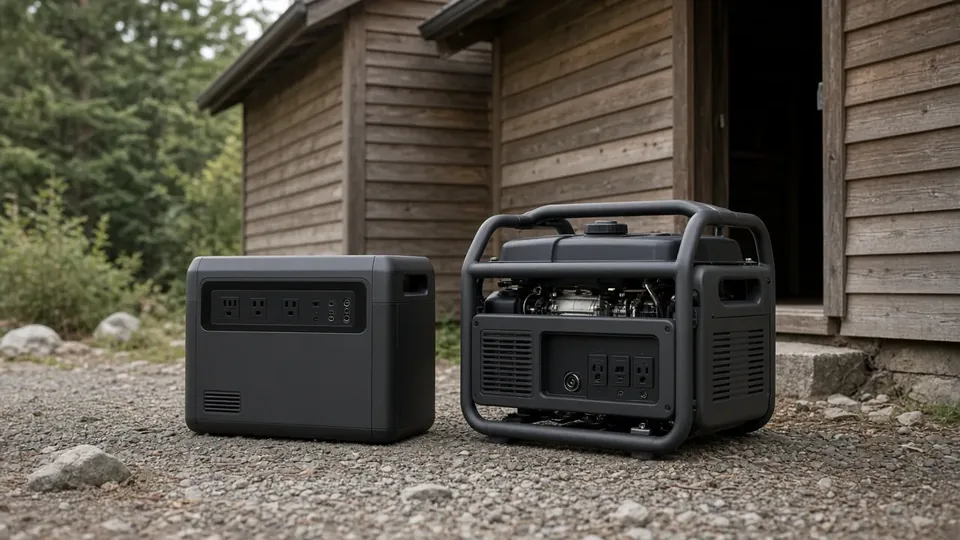
When you're planning a weekend trip to your cabin, one of the first questions that comes up is: Should I bring a portable power station or a gas generator? Both options have their pros and cons, and the right choice depends on your specific needs, the equipment you plan to use, and your personal preferences.
Portable power stations are quiet, clean, and easy to store. They can power small appliances like lights, phones, and small fridges. Gas generators are more powerful and can run indefinitely as long as you have fuel, but they are louder, emit carbon monoxide, and require more maintenance.
Let's break down the key differences and help you decide which option is better for your weekend cabin.
Key Differences Between Portable Power Stations and Gas Generators
1. Noise and Emissions
Portable power stations are completely silent, making them ideal for early mornings or late nights when you want to enjoy the peace of the woods. They also produce no emissions, so you don't have to worry about carbon monoxide or air quality.
Gas generators, on the other hand, are noisy and emit carbon monoxide. They must be used outdoors and kept at least 20 feet away from any doors, windows, or vents to prevent carbon monoxide poisoning (CPSC; CDC).
2. Fuel and Runtime
Portable power stations are powered by batteries and have a limited runtime. Their runtime depends on the battery capacity and the load you're running. For example, a 2,000 Wh power station can run a 80 W load for about 21 hours (2,000 x 0.85 / 80 = 21 h).
Gas generators, by contrast, run as long as you have fuel. A 1,000 W gas generator can run indefinitely if you have a fuel supply, but you'll need to store and manage fuel, which can be a hassle.
3. Power Output and Surge Capacity
Portable power stations typically have a lower continuous power output compared to gas generators. Most portable stations range from 500 W to 2,000 W, while gas generators can go up to 10,000 W or more. However, portable stations often have a surge capacity that can handle short bursts of higher power, like when a refrigerator starts up.
Gas generators are better for high-power appliances like air conditioners, electric heaters, and large fridges. They can also handle surges more easily, which is important for appliances that require a lot of power to start.
4. Maintenance and Cost
Portable power stations require minimal maintenance. They don't need oil changes, filters, or fuel storage. They are also more expensive upfront, but they have no ongoing fuel costs.
Gas generators require regular maintenance, including oil changes, filter replacements, and fuel storage. They are generally less expensive upfront, but they have ongoing fuel costs and require more maintenance over time.
5. Portability and Storage
Portable power stations are lightweight and easy to carry. They can be stored in a closet or on a shelf when not in use. They are also easier to move around your cabin or campsite.
Gas generators are heavier and bulkier. They require more space for storage and are harder to move around. They also need to be kept outdoors and away from your cabin, which can be inconvenient.
What to Look for in a Portable Power Station
If you're considering a portable power station for your weekend cabin, here are some key features to look for:
- Battery Capacity (Wh): Look for a station with at least 1,000 Wh to power small appliances and lights. For larger appliances, consider a 2,000 Wh or higher station.
- Continuous Power Output (W): Choose a station with a continuous power output of at least 500 W. For larger appliances, look for a station with 1,000 W or more.
- Surge Capacity (W): Look for a station with a surge capacity that can handle the starting power of your appliances. For example, a refrigerator may require a surge of 1,500 W.
- Inverter Efficiency: Look for a station with an inverter efficiency of at least 85% to ensure you get the most power out of your battery.
- Charging Options: Look for a station that can be charged via wall outlet, car charger, or solar panels. This gives you more flexibility and options for recharging.
- Weight and Portability: Choose a station that is lightweight and easy to carry. Look for models with handles or wheels for easier transport.
What to Look for in a Gas Generator
If you're considering a gas generator for your weekend cabin, here are some key features to look for:
- Power Output (W): Look for a generator with a power output of at least 1,000 W. For larger appliances, consider a generator with 2,000 W or more.
- Fuel Type: Choose a generator that runs on gasoline or propane. Gasoline generators are more common, but propane generators are cleaner and safer.
- Noise Level: Look for a generator with a noise level of at least 60 dB or lower. This will help reduce noise and disturbance.
- Emissions: Look for a generator that meets EPA standards for emissions. This will help reduce your environmental impact.
- Surge Capacity (W): Look for a generator with a surge capacity that can handle the starting power of your appliances. For example, a refrigerator may require a surge of 1,500 W.
- Fuel Storage: Look for a generator with a fuel tank that can last for several hours. This will help reduce the need for frequent refueling.
- Weight and Portability: Choose a generator that is lightweight and easy to carry. Look for models with handles or wheels for easier transport.
Worked Example
Let's say you're planning a weekend trip to your cabin and you want to power a few small appliances. You have a 1,500 Wh portable power station and a 1,000 W gas generator.
Portable Power Station
- Battery Capacity: 1,500 Wh
- Load: 100 W (lights, phone charger, small fridge)
- Runtime: 1,500 x 0.85 / 100 = 12.75 hours
This means your portable power station can run your appliances for about 12.75 hours. If you need more runtime, you could consider a larger station or a solar panel to recharge it.
Gas Generator
- Power Output: 1,000 W
- Load: 100 W (lights, phone charger, small fridge)
- Runtime: As long as you have fuel
This means your gas generator can run your appliances indefinitely as long as you have fuel. However, you'll need to store and manage fuel, and you'll need to keep the generator outdoors and away from your cabin.
Who This Is Not For
This page is not for people who need continuous power for large appliances or who are looking for a backup power solution for their home. It is also not for people who are concerned about noise or emissions and prefer a quiet, clean power source.
FAQ
What is the difference between a portable power station and a gas generator?
A portable power station is powered by batteries and is quiet and emission-free. A gas generator is powered by fuel and is louder and emits carbon monoxide.
Which is better for small appliances?
A portable power station is better for small appliances like lights, phones, and small fridges. It is quiet and emission-free.
Which is better for large appliances?
A gas generator is better for large appliances like air conditioners, electric heaters, and large fridges. It has a higher power output and can run indefinitely as long as you have fuel.
Can a portable power station power a refrigerator?
Yes, a portable power station can power a refrigerator, but it depends on the battery capacity and the power output of the station. A 2,000 Wh station with a 1,000 W continuous power output can power a small refrigerator.
Can a gas generator power a refrigerator?
Yes, a gas generator can power a refrigerator. It has a higher power output and can run indefinitely as long as you have fuel.
Related Pages
- p01 - How to Size Off-Grid Power for a Weekend
- p04 - How Much Battery Capacity Do You Need for a Weekend
- p05 - Calculate Runtime Hours from Any Power Station
- p08 - Size a Generator for Cabin, RV, and Home-Backup Surge
- p10 - Worked Load and Capacity Example for a Typical Weekend Cabin
- p25 - Solar-Only Weekend Systems Versus Solar-Plus-Generator Hybrids
- p26 - Total Cost of Ownership for Weekend Power Systems
Sources to Cite
- CDC/CPSC - Carbon monoxide safety guidelines
- EPA - Emissions standards for generators
- Watt-Hours, Watts, and the Five Formulas You Actually Use - Formula for calculating runtime hours