Size Power for a Weekend RV Boondocking Trip
Updated 2026-10-21 · Published by Charland & Co. · Based on published specs; we have not tested the products discussed.
Quick answer: For a weekend RV boondocking trip, you'll need a power station with 2,200-2,600 Wh capacity. Pair it with 150-200 W of solar panels for full-day recharging.
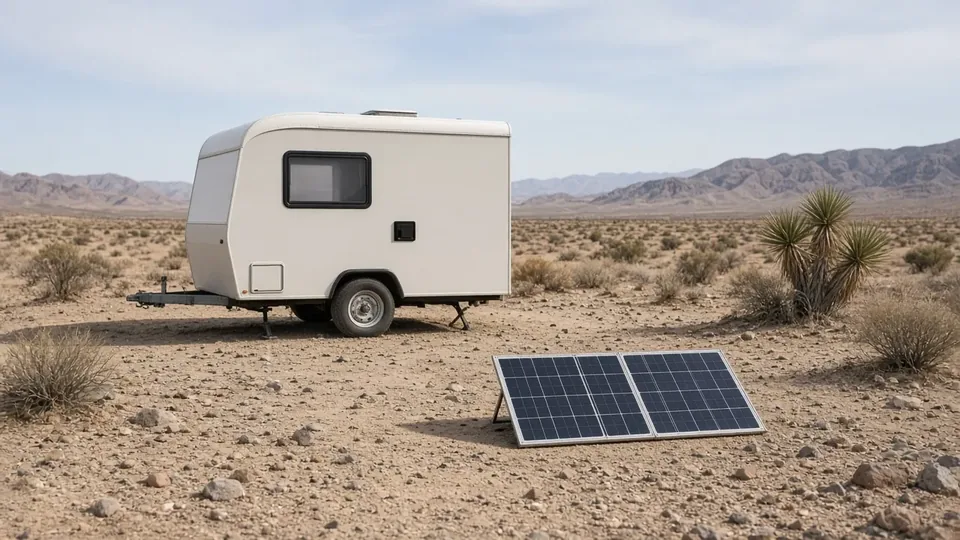
When boondocking in your RV, you're off the grid and relying on your portable power station to keep your lights on, your fridge running, and your devices charged. Sizing the right power station and solar system for a weekend trip is about knowing your load, calculating how much battery you need, and how much solar you'll need to recharge it.
This guide walks you through the formulas and steps to size your power station and solar system for a weekend trip. It's based on real-world usage and the formulas used by engineers and power system designers.
Understanding Your Load
The first step is to build a list of all the devices you'll be using during your trip. This includes lights, the fridge, water pump, phone chargers, and any other small appliances.
For example, a typical weekend RV load might include:
- LED lights: 10 W
- Fridge: 100 W (but only runs 20% of the time)
- Water pump: 50 W (used for 10 minutes every hour)
- Phone chargers: 10 W
- Coffee maker: 500 W (used for 10 minutes)
- Laptop: 60 W
To calculate your daily load in watt-hours (Wh), you need to multiply the wattage of each device by the number of hours it runs in a day.
Example:
- LED lights: 10 W × 24 hours = 240 Wh
- Fridge: 100 W × 0.2 (20% duty cycle) × 24 hours = 480 Wh
- Water pump: 50 W × 0.167 (10 minutes every hour) × 24 hours = 200 Wh
- Phone chargers: 10 W × 2 hours = 20 Wh
- Coffee maker: 500 W × 0.167 (10 minutes) × 1 hour = 83 Wh
- Laptop: 60 W × 2 hours = 120 Wh
Total daily load = 240 + 480 + 200 + 20 + 83 + 120 = 1,143 Wh
This is your daily Wh.
Calculating Battery Capacity Needed
Now that you know your daily load, you can calculate how much battery capacity you'll need for your trip. The formula is:
Battery Wh needed = daily Wh × days × 1.2
The 1.2 factor accounts for inefficiencies in the system, such as inverter losses, battery degradation, and unexpected usage.
Example:
- Daily Wh = 1,143
- Days = 2
- 1.2 factor = 1.2
Battery Wh needed = 1,143 × 2 × 1.2 = 2,743 Wh
So, you'll need a power station with at least 2,743 Wh of battery capacity. However, portable power stations are not 100% efficient. The inverter efficiency is typically around 85%, so you'll need to account for that as well.
Cold-weather usable Wh = Wh × 0.85 (for cold weather)
Cold-weather usable Wh = 2,743 × 0.85 = 2,331 Wh
So, you'll need a power station with at least 2,331 Wh of usable capacity.
But since power stations are not 100% efficient, and cold weather further reduces usable capacity, you'll want to round up to the next available size. In this case, a 2,500 Wh power station would be ideal.
Calculating Solar Charging Needs
If you plan to recharge your power station using solar panels, you'll need to calculate how much solar capacity you'll need. The formula is:
Solar Wh per day = panel W × peak sun hours × 0.75
The 0.75 factor accounts for losses due to dust, angle of the panel, and other inefficiencies.
Example:
- Panel W = 150 W
- Peak sun hours = 5 (average in the US)
- 0.75 factor = 0.75
Solar Wh per day = 150 × 5 × 0.75 = 562.5 Wh
So, a 150 W solar panel would provide about 562.5 Wh of energy per day.
If you need to recharge your 2,500 Wh power station in one day, you'll need:
Total Wh to recharge = 2,500 Wh
Solar Wh per day = 562.5 Wh
Number of panels needed = 2,500 / 562.5 = 4.44
So, you'll need 5 solar panels of 150 W each to fully recharge your power station in one day.
Choosing the Right Power Station and Solar Panels
When choosing a power station for your weekend trip, look for one with:
- At least 2,500 Wh of battery capacity
- A continuous output of 1,000 W or more
- A surge capacity of 2,000 W or more (for devices that require a lot of power to start)
- USB, AC, and DC ports for your devices
- A built-in inverter and battery management system
For solar panels, look for:
- 150 W or more per panel
- Foldable or rigid panels that are easy to set up and store
- Panels with a long power-output warranty and high efficiency; compare both on the panel's spec sheet
- Panels that are compatible with your power station's charging system
Worked Example
Let's say you're planning a weekend trip and your load is as follows:
- LED lights: 10 W × 24 hours = 240 Wh
- Fridge: 100 W × 0.2 × 24 hours = 480 Wh
- Water pump: 50 W × 0.167 × 24 hours = 200 Wh
- Phone chargers: 10 W × 2 hours = 20 Wh
- Coffee maker: 500 W × 0.167 × 1 hour = 83 Wh
- Laptop: 60 W × 2 hours = 120 Wh
Total daily load = 240 + 480 + 200 + 20 + 83 + 120 = 1,143 Wh
Battery Wh needed = 1,143 × 2 × 1.2 = 2,743 Wh
Cold-weather usable Wh = 2,743 × 0.85 = 2,331 Wh
So, you'll need a power station with at least 2,500 Wh of battery capacity.
For solar panels:
- Solar Wh per day = 150 W × 5 × 0.75 = 562.5 Wh
- Number of panels needed = 2,500 / 562.5 = 4.44 → 5 panels
So, you'll need 5 solar panels of 150 W each to fully recharge your power station in one day.
Who This Is Not For
This guide is for weekend RV boondockers who want to size a portable power station and solar system for a short trip. It is not for:
- Full-time RVers who need power for weeks or months
- People who want to power a home or cabin with a portable station
- Those who need to power high-wattage appliances like air conditioners or electric stoves
- Anyone who plans to use their power station for commercial or industrial purposes
FAQ
What is the difference between battery Wh and runtime hours?
Battery Wh is the total energy stored in the battery, while runtime hours is how long the battery will last when powering a specific load. The formula to calculate runtime hours is:
Runtime hours = battery Wh × 0.85 / load W
Can I use a smaller power station if I have solar panels?
Yes, but you'll need enough solar panels to recharge the battery fully. If you have a smaller power station, you'll need more solar panels to recharge it quickly.
How do I know if my power station can handle my fridge?
Check the power station's continuous output and surge capacity. Your fridge will require a continuous output of at least 100 W and a surge capacity of at least 500 W.
Can I use my power station to power my RV's AC?
No, unless your power station has a high continuous output (at least 1,500 W) and a high surge capacity (at least 3,000 W). Most portable power stations are not designed to power AC units.
What if I don't have access to solar panels?
You can still use a power station, but you'll need to recharge it using a wall outlet or a car charger. Make sure your power station has a wall or car charging option.
Related Pages
- p01 How to Size Off-Grid Power for a Weekend
- p03 Build an Accurate Weekend Load List for Cabins, RVs, and Camps
- p04 How Much Battery Capacity Do You Need for a Weekend
- p05 Calculate Runtime Hours from Any Power Station
- p07 Size Solar Panels for a Weekend Power Station
- p10 Worked Load and Capacity Example for a Typical Weekend Cabin
- p15 500 Wh Versus 1,000 Wh Versus 2,000 Wh Stations for Weekends
- p20 Buying Guide: Choosing a Portable Power Station for Weekend Use
Sources to Cite
- NREL PVWatts — peak sun hours for your location: https://pvwatts.nrel.gov/
- Your device and station manuals — surge ratings
[DATE]
[CONTACT EMAIL]