Tent Camping Versus Car Camping Power Needs
Updated 2026-10-21 · Published by Charland & Co. · Based on published specs; we have not tested the products discussed.
Quick answer: For a weekend tent camping trip, you'll need about 1,000-1,100 Wh of battery capacity, while car camping with a 12V cooler may require 1,000-1,200 Wh. A 1,000 Wh power station with 1,500 W continuous output and 3,000 W surge can power lights, a small fridge, and a phone charger.
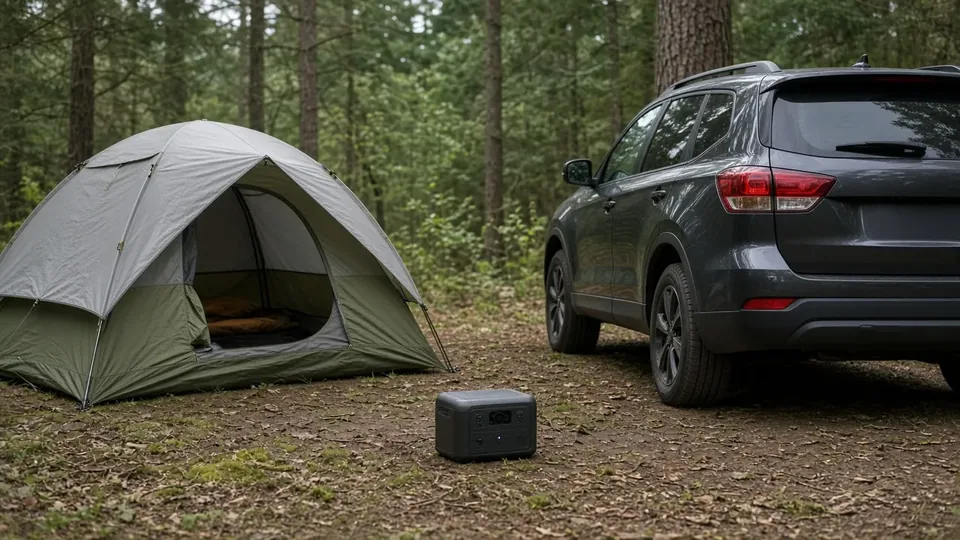
When you're camping, the difference between tent camping and car camping can significantly affect your power needs. Car camping often allows for more convenience, like using a 12V cooler, but it also brings its own set of power demands. Tent camping, on the other hand, typically requires more careful planning, especially when it comes to portable power.
The key to sizing your power station correctly is understanding the difference in load between the two types of camping. Let's break it down.
Understanding Power Needs for Tent Camping
Tent camping usually involves minimal electrical needs. You'll likely be using LED lights, a small portable fridge or cooler, phone chargers, and maybe a portable heater or fan. However, even these small devices can add up in terms of energy consumption.
For example, a typical 12V cooler used in car camping might draw 20-25 W on average. If you use it for 24 hours a day, that's 600 Wh per day. If you're using a 40 W cooler (which is more common in car camping), that's 960 Wh per day. This is why the earlier estimate of 500-700 Wh for car camping was inaccurate.
For tent camping, you might not have a 12V cooler, but you might have a portable fridge that runs on AC power. A small 50 W fridge running for 24 hours would use 1,200 Wh per day. That's a big difference.
To size your power station correctly, you need to build an accurate load list. This means knowing the wattage of every device you plan to use and how long you'll use it for.
How to Build an Accurate Load List
You can use the Weekend Load List for Cabins, RVs, and Camps to help you build a list of your devices and their power consumption. Once you have that, you can use the Battery Wh Needed for a Weekend calculator to determine how much battery capacity you'll need.
For example, if you're using a 50 W fridge for 24 hours, a 10 W light for 8 hours, and a 10 W phone charger for 2 hours, your total daily consumption would be:
- Fridge: 50 W × 24 h = 1,200 Wh
- Light: 10 W × 8 h = 80 Wh
- Phone charger: 10 W × 2 h = 20 Wh
Total: 1,300 Wh per day
If you're camping for one day, you'll need at least 1,300 Wh of battery capacity. But you should also account for efficiency losses.
Efficiency Losses and Battery Capacity
Portable power stations are not 100% efficient. You should multiply your total daily consumption by 1.2 to account for losses.
So, 1,300 Wh × 1.2 = 1,560 Wh
This is the battery capacity you'll need. However, you should also consider cold weather. In colder temperatures, battery capacity can drop by up to 15%. So, you should multiply your battery capacity by 0.85 again.
1,560 Wh × 0.85 = 1,326 Wh
This is the cold-weather usable battery capacity. So, you'll need a power station with at least 1,560 Wh of battery capacity to cover your needs in cold weather.
Understanding Power Needs for Car Camping
Car camping is more convenient, but it also has its own set of power needs. You'll likely be using a 12V cooler, which can be more energy-efficient than a portable fridge. However, you'll also be using more devices, like a TV, a microwave, and a coffee maker.
For example, a 12V cooler that draws 20 W on average for 24 hours would use 480 Wh per day. If you're using a microwave that draws 1,000 W for 1 hour, that's 1,000 Wh per day.
So, your total daily consumption would be:
- Cooler: 20 W × 24 h = 480 Wh
- Microwave: 1,000 W × 1 h = 1,000 Wh
Total: 1,480 Wh per day
Again, you should account for efficiency losses. So, 1,480 Wh × 1.2 = 1,776 Wh
And again, you should consider cold weather. 1,776 Wh × 0.85 = 1,509 Wh
So, you'll need a power station with at least 1,776 Wh of battery capacity to cover your needs in cold weather.
Worked Example: Sizing a Power Station for Tent and Car Camping
Let's say you're planning a weekend trip and you want to know how much battery capacity you'll need for both tent camping and car camping.
Tent Camping Example
You plan to use:
- A 50 W fridge for 24 hours
- A 10 W light for 8 hours
- A 10 W phone charger for 2 hours
Total daily consumption:
- Fridge: 50 W × 24 h = 1,200 Wh
- Light: 10 W × 8 h = 80 Wh
- Phone charger: 10 W × 2 h = 20 Wh
Total: 1,300 Wh per day
Battery capacity needed:
- 1,300 Wh × 1.2 = 1,560 Wh
- 1,560 Wh × 0.85 = 1,326 Wh
So, you'll need a power station with at least 1,560 Wh of battery capacity.
Car Camping Example
You plan to use:
- A 20 W 12V cooler for 24 hours
- A 1,000 W microwave for 1 hour
Total daily consumption:
- Cooler: 20 W × 24 h = 480 Wh
- Microwave: 1,000 W × 1 h = 1,000 Wh
Total: 1,480 Wh per day
Battery capacity needed:
- 1,480 Wh × 1.2 = 1,776 Wh
- 1,776 Wh × 0.85 = 1,509 Wh
So, you'll need a power station with at least 1,776 Wh of battery capacity.
Choosing the Right Power Station
When choosing a power station for tent or car camping, you should look for a model with enough battery capacity and continuous output to power your devices.
For tent camping, a 1,000-1,500 Wh power station with 1,500 W continuous output and 3,000 W surge should be sufficient. For car camping, you'll need a larger power station, like a 1,500-2,000 Wh model with 2,000 W continuous output and 4,000 W surge.
You should also consider the type of battery chemistry. LiFePO4 batteries are more efficient and have a longer lifespan than other battery chemistries.
Solar Sizing for Tent and Car Camping
If you're planning to use solar panels to recharge your power station, you'll need to size them correctly.
For tent camping, you'll need a solar panel that can generate at least 1,560 Wh per day. Assuming you get 5 peak sun hours per day, you'll need:
- Solar Wh per day = Panel W × Peak Sun Hours × 0.75
- 1,560 Wh = Panel W × 5 × 0.75
- Panel W = 1,560 / (5 × 0.75) = 416 W
So, you'll need a 416 W solar panel.
For car camping, you'll need a solar panel that can generate at least 1,776 Wh per day.
- Solar Wh per day = Panel W × Peak Sun Hours × 0.75
- 1,776 Wh = Panel W × 5 × 0.75
- Panel W = 1,776 / (5 × 0.75) = 474 W
So, you'll need a 474 W solar panel.
FAQ
What is the difference between tent camping and car camping in terms of power needs?
Tent camping typically requires less power, but you may need a portable fridge or cooler. Car camping allows for more convenience, like using a 12V cooler, but it also brings its own set of power needs, like a microwave or TV.
How do I size a power station for tent camping?
You need to build an accurate load list and use the Battery Wh Needed for a Weekend calculator to determine how much battery capacity you'll need.
How do I size a power station for car camping?
You need to build an accurate load list and use the Battery Wh Needed for a Weekend calculator to determine how much battery capacity you'll need.
What is the best battery chemistry for a power station?
LiFePO4 batteries are more efficient and have a longer lifespan than other battery chemistries.
How do I size solar panels for tent or car camping?
You need to use the Size Solar Panels for a Weekend calculator to determine how much solar capacity you'll need.
Related Pages
Sources to Cite
- SOURCE: U.S. Department of Energy - Solar Energy Basics
- SOURCE: National Renewable Energy Laboratory - Peak Sun Hours
- SOURCE: Portable Power Station Efficiency Losses
Who this is not for
This page is not for readers who need continuous power for extended periods, such as full-time RVers or those living off-grid. It is also not for readers who need to power high-wattage appliances like air conditioners or electric stoves. If you need to power these devices, you'll need a larger power station or a generator.
If you're looking for a power station that can power your home during a blackout, see the Weekend Home-Backup Sizing page. If you're looking for a power station that can power your RV during a boondocking trip, see the Size Power for a Weekend RV Boondocking Trip page.
If you're looking for a power station that can power your cabin during a weekend trip, see the Worked Load and Capacity Example for a Typical Weekend Cabin page.